
Luckily, the film survives today in near-complete form, making it possible to describe it:
Achmed, the philandering son of a wealthy Ottoman pasha, promises his father to mend his ways. He disguises himself as a beggar to search for a worthy wife, and falls in love with Enis Aldjelis, whose love he wins in return. They marry after overcoming several obstacles, but Achmed proves an unfaithful husband, making Enis's life miserable.
The unique nitrate print of Enis Aldjelis, die Blume des Ostens surfaced in the Netherlands in the 1980s and was repatriated to Austria in 1986. Until its restoration by Filmarchiv Austria in 1991, the film had gone unseen for decades and almost nothing was known about it. Even today, many ambiguities surround it.
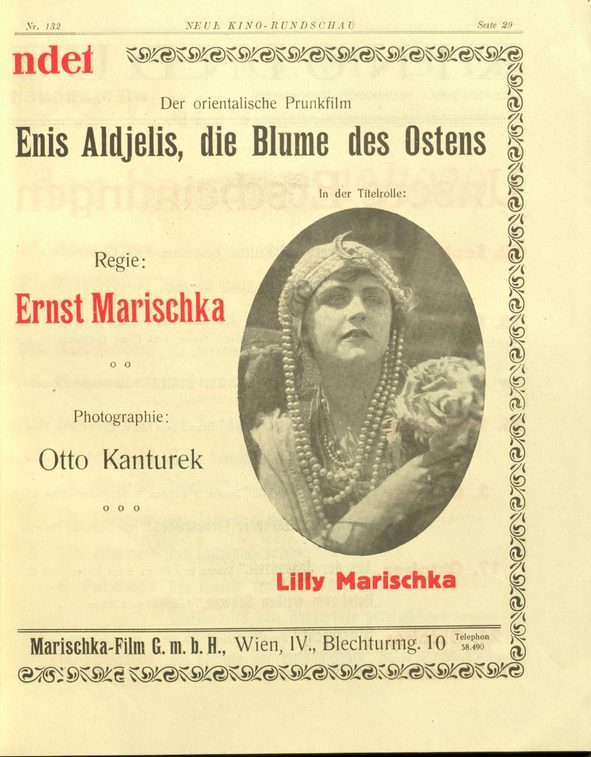
New research, only possible now thanks to the global availability of historical newspapers and other databases, sheds fresh light on the film's protagonists and production circumstances. At the same time, these sources reveal that the film's original promotion was confusing, and at times even contradictory, perhaps intentionally so. Some German newspapers and magazines referred to the film as Enis Aldjelis, die Rose des Ostens at the time of its 1920 release. Abroad, the exported film was advertised under translated titles, with the names of actors and characters spelled differently from source to source. And although the film was released in 1920 as a recent production (‘soeben fertiggestellt’: just completed), the actual shooting had taken place about two years earlier.
Enis Aldjelis, die Blume des Ostens: an orientalist enigma from the past
Enis Aldjelis, die Blume des Ostens (1920) is an Austrian silent film with more mysteries than answers. Shot in Istanbul but seemingly unknown to Turkish film history, released as a novelty but filmed years earlier, starring an actress whose real name and life story vanished from the record. Drawing on newly available historical newspapers and archives, Eye curator Elif Rongen-Kaynakçi traces the film's tangled production history and uncovers what became of the people who made it.
By Elif Rongen-Kaynakçi25 August 2026
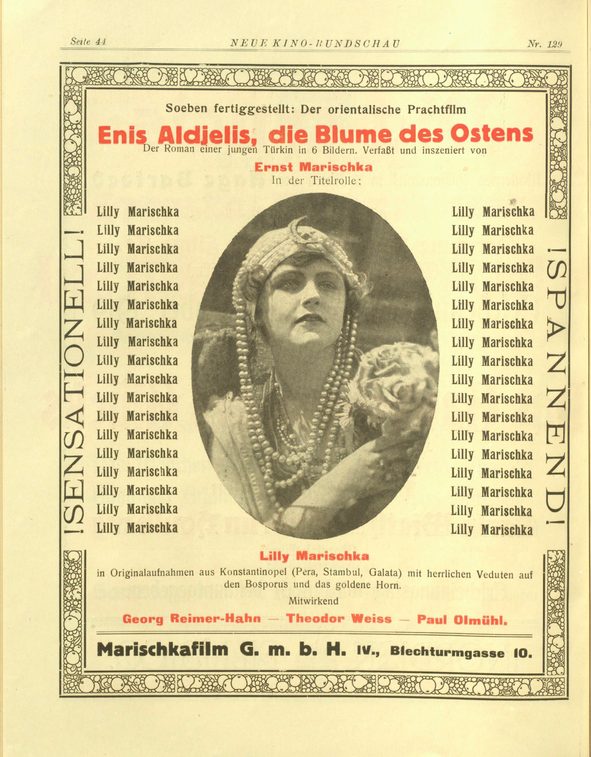
Sensational! Exciting! The story of a young Turkish Woman… An oriental love story… Original locations in Constantinople with beautiful views of the Bosphorus and the Golden Horn… Written and directed by Ernst Marischka… Starring Lilly Marischka…
In 1920, newspapers enthusiastically advertised Enis Aldjelis, die Blume des Ostens as an epic love story set in the East, giving little away about the plot itself.
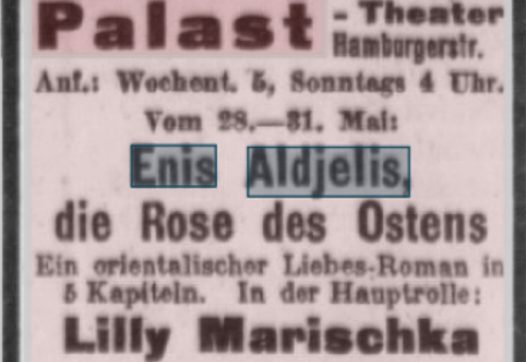

Watching Enis Aldjelis today raises many questions. The film was clearly shot on the streets of Istanbul with a mainly Austrian cast and crew. Yet despite Austrian sources describing it as a sizeable, newsworthy production that drew crowds on the streets of Istanbul, Turkish film history makes no mention of it, neither officially, nor in personal memoirs. No local magazine or newspaper articles about it are currently known.
At the time of its 1920 release, Enis Aldjelis already represented a political impossibility. How could Austrians, defeated in WWI alongside the Ottoman Empire, roam the streets of Istanbul filming a melodrama, while victorious British and French forces occupied the city from November 1918 to 1923? And how could anyone make a feature-length film in a country with hardly any film production facilities?
In search of answers, here is an attempt to piece together the careers of the protagonists and reconstruct the context in which the film was made.
Directors and actors
The Marischka brothers and the Marischka-Filmgesellschaft
Although best remembered today for his later films, Ernst Marischka (1893-1963) was an ambitious director from the very start of his career. Born in Vienna, he started working in the film industry at a young age, like his brother Hubert. He had already written his first script by 1913, and although he continued mainly as a writer, he also directed films occasionally from 1915 onwards. His big break came only in 1954, when Mädchenjahre einer Königin became an international hit, followed by Sissi in 1955, both starring Romy Schneider. Several sequels soon followed.
Hubert Marischka (1882-1959) had already established himself as a successful opera singer before 1910, and acted regularly in films from 1913 to 1932. He went on to become a well-known film and opera director and scriptwriter until his death.
In Vienna, Ernst and Hubert founded the Marischka-Filmgesellschaft during WWI. The company appears to have operated until the mid-1920s and Enis Aldjelis was probably its first production.
Lilly Marischka as Enis Aldjelis
The star of the film, Lilly (also Lily, or Lilli) Marischka (1900-1978), was Ernst Marischka's soon-to-be wife, promoted as the star of the Marischka-Filmgesellschaft. Yet until recently, some confusion surrounded her true identity. Thanks to the researchers of Filmmuseum Austria, where the Marischka family papers are kept, we now know she was born in Vienna as Karoline Bobrowsky. She married Ernst on 11 August 1918 and gave birth to their daughter Mady on 8 March 1919.
Despite her star status around 1920, when she graced the covers of film magazines, she gradually faded into the background of her husband's production company. Her acting career was forgotten within her own lifetime, and she was practically written out of film history.
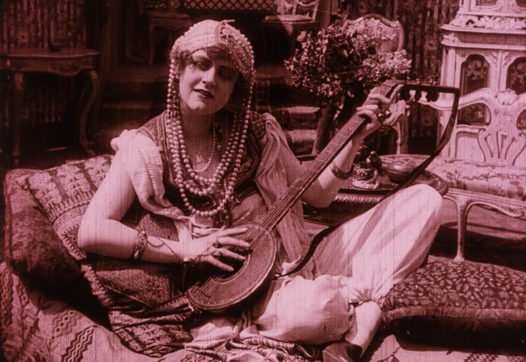
still Enis Aldjelis, die Blume des Ostens (Ernst Marischka, AT 1920)
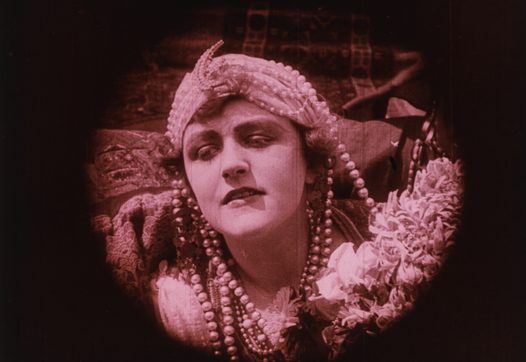
still Enis Aldjelis, die Blume des Ostens (Ernst Marischka, AT 1920)
Georg Reimer-Hahn as Achmed
Very little is known about Georg Reimer-Hahn, who played Achmed. To this day, sources spell his name in widely different ways, causing confusion, potentially with other people.
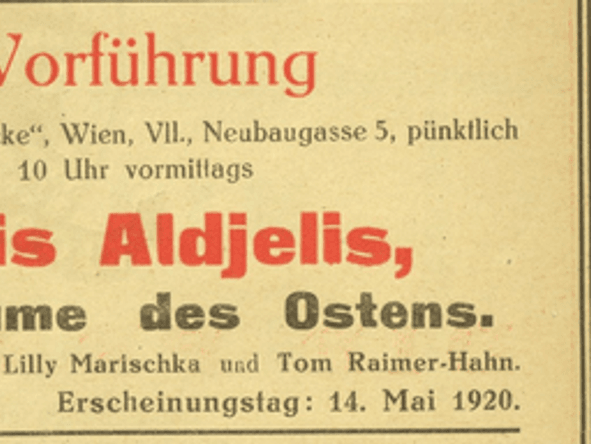
This ambiguity seems to date back to the start: an Austrian advertisement for Enis Aldjelis in Neue Kino Rundschau lists his name as Tom Raimer-Hahn. However, an obituary written by Edith Helen Gitana in Filmwelt in 1922 fills in more details of his career, and confirms that Reimer-Hahn died at just 28 years old, in 1922.
In an earlier interview published in Filmwelt in 1921, the same journalist had spoken to him at length, including about his adventures in Istanbul with the Marischkas. His poor health and early death meant his filmography stayed limited to a handful of films, which explains his anonymity today.
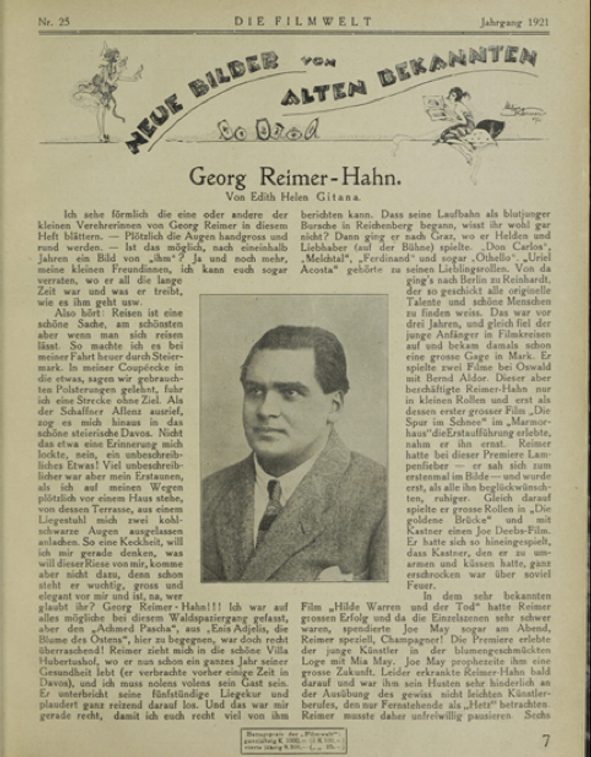
How and when was Enis Aldjelis actually shot?
A long report Ernst Marischka wrote for Kinowoche in 1920 clarifies some production details. Under the title ‘Mein film-kreuzzug’ (‘My Film Crusade’), he describes boarding the Orient Express in 1917 for Constantinople, together with his troupe: his brother Hubert, his wife Lilly, and the actors Georg Reimer-Hahn, Theodor Weiss and Ludwig Stärk. Lothar Ring joined them as ‘dramaturg’. After picking up a few extra actors from Sofia Royal Theatre in Bulgaria, they finally reached their destination.
“My intention was clear: I wanted to make a film that would generate interest abroad… For that, I needed the exotic subject matter and the exotic scenic setting. Since I didn't know how far we would get, I had to adapt to my own process. I couldn't determine the film's plot beforehand, but had to rely on developing it later, once the film was shot, from the scenic possibilities that presented themselves.”
"… First, we had to clear the way with the authorities. We were prepared for resistance and also knew the means to overcome it: bachsish [tip or bribe money]."
"… We brought some of the extras with us from Sofia, and some were recruited by the assistant directors at the Turkish theater. It was a rather motley crew that we managed to keep together in the end: Armenians, Greeks, Bulgarians."
"… Wherever we went, the commotion was enormous. People crowded around us, and we very often had an excessive number of volunteer extras in the pictures. The police had to intervene several times to clear the way."
"…. We traveled through all the districts of Constantinople, filming in Pera, Galata, and Eyüp; we also crossed the Bosphorus and visited Skutari (Üsküdar) and Yemkö [sic, Yeniköy?]."
"… The result of the stay, which lasted six weeks, are the two films Der Prinz von Pera (The Prince of Pera) and Enis Aldelis [sic], die Blume des Ostens (Enis Aldjelis, the Flower of the East). Since we couldn't develop down there, it was only after our return that we were able to cut out the unsuccessful parts. We reshot them in a Viennese studio."
"I am satisfied with the result. The two works, which will soon also be released in Vienna, represent a complete artistic, and since they were sold to America and Germany, also a commercial success.”
– excerpts from ‘Mein film-kreuzzug’ in Kinowoche (vol. 3, 1920).
Additionally, Enis Aldjelis was also sold to the Netherlands, where it received enthusiastic reviews from the local press. One advertisement even called it “The first Turkish film in the Netherlands. Something very extraordinary!” (Utrechtsch provinciaal en stedelijk dagblad, 9 July 1920)
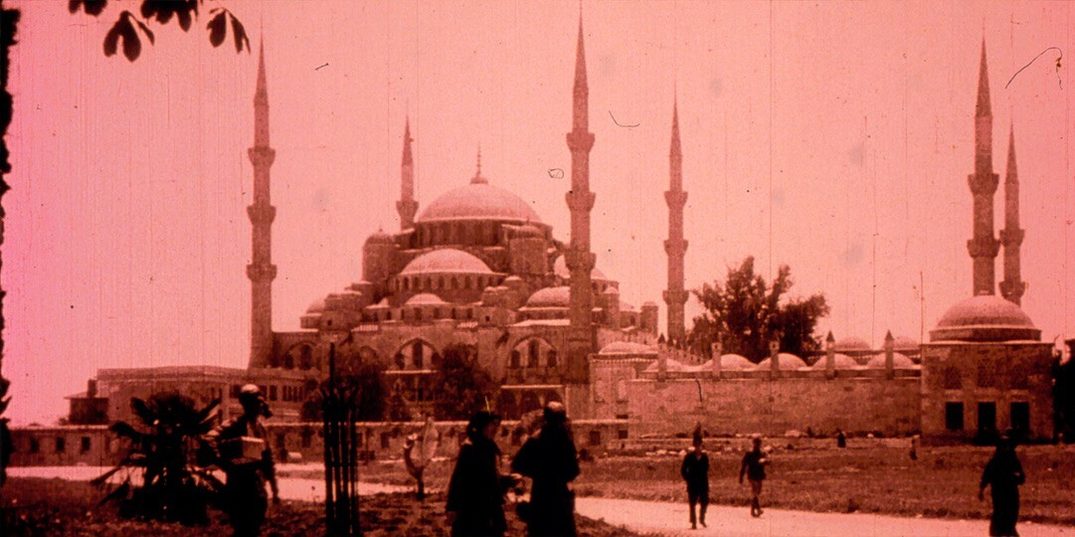
The Marischkas were clearly eager to tap into the Orientalist fashions of the time. By 1920, Western cinema was churning out one exotic love story after another: Die Rose von Stambul (A. Wellen, DE 1919), Sumurun (E. Lubitsch, DE 1920), Die Todeskarawane (J. Stein, DE 1920), La Sultane d'amour (Somptier & Burguet, FR 1919), The Right to Love (G. Fitzmaurice, US 1920), not to mention the worldwide success of the ‘Maharadja’ films starring Gunnar Tolnaes in the title role since 1916. Yet none of these films were actually shot in Istanbul, and the Marischkas must have felt they had struck gold. Location shooting is exactly what sets Enis Aldjelis apart: showing everyday street life gives the film documentary-like scenes. Istanbul's most emblematic landmarks – the Blue Mosque, the Galata Bridge, Eyüp – all feature in the scenery.
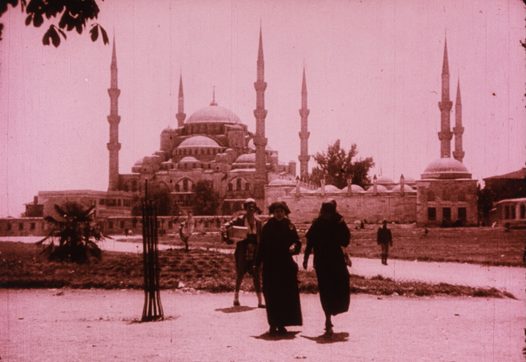
still Enis Aldjelis, die Blume des Ostens (Ernst Marischka, AT 1920)
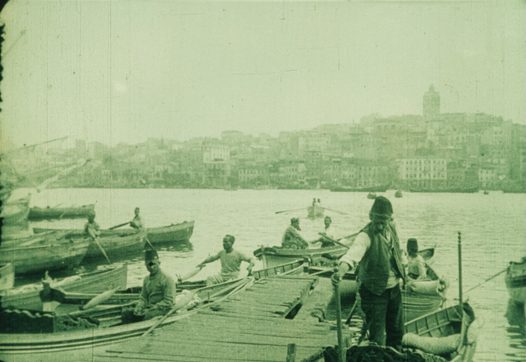
still Enis Aldjelis, die Blume des Ostens (Ernst Marischka, AT 1920)
As noted above, although the film was released in 1920, the footage was shot earlier, confirming Marischka's pioneering instinct for exotic content. But his memory seems to go back too far: he claims their trip to Istanbul took place in 1917. Putting the pieces of the puzzle together, it's more likely they were in Istanbul in June-July 1918. The clues lie in Marischka's own account:
“I still regret today that we were unable to film the great fire of Constantinople which raged during our stay. However, an event that we did capture with our camera was the Sultan's funeral. We were in the middle of shooting a street scene when the procession passed by [...] The procession was flanked by two rows of women waving handkerchiefs. We filmed the scene and improvised a connection to the film's plot.” (from Kinowoche, vol. 3, 1920)
In his 1921 interview in Filmwelt, Reimer-Hahn confirms this: "Marischka wanted to film the Sultan there at the time, but arrived just in time for the Sultan's funeral, and undaunted, went ahead filming."
The ‘great fire of Constantinople’ mentioned here is probably the Cibali fire that broke out on 10 June 1918 and burned for a couple of days. Sultan Mehmed Reshad died on 3 July from heart failure, or perhaps the Spanish flu. His funeral procession took place on 4 July 1918.
Writing ‘My Film Crusade’ in 1920, in retrospect, Marischka naturally referred to Lilly as his wife, although they had not yet officially married while shooting Enis Aldjelis. Their wedding took place in Vienna on 11 August 1918, probably right after their return from Istanbul (perhaps once they had discovered Lilly was pregnant).
Reimer-Hahn's filmography also suggests the trip could not have taken place in 1917. Having made around five films that year, he apparently fell ill shortly after the premiere of Hilde Warren und der Tod, held on 31 August 1917 at the Tauentzien-Palast in Berlin. Only about six months later had he regained enough strength to join the Marischkas on their journey to Constantinople and pick up his film career again. (Filmwelt, 1921, no. 25)
The images of the Sultan's funeral do not appear in Enis Aldjelis. This footage was probably used for the other film, Der Prinz Von Pera, advertised as an ‘Italian spy story’ in Film und Presse (no. 3, 1920), allegedly produced by a Hungarian company called Luna Film. Very few other references to this film survive today, but an advertisement in the Münchner neueste Nachrichten (16 July 1920) opens up further intriguing questions. We know from his own account that Reimer-Hahn also appeared in this film, yet the advertisement names Hubert Marischka and Lili Bobrovska as its main stars. Given the small size of the cast and crew, and that Lilly Marischka's birth name was Karoline Bobrowsky, it seems very likely that the same actress starred in both films, under a different stage name.
Unfortunately, Enis Aldjelis' ‘twin film’ Der Prinz Von Pera remains a lost film, which makes Enis Aldjelis all the more remarkable as a unique historical document. Its cinematographic achievements may not be especially significant, but Enis Aldjelis still offers a fascinating glimpse into the peculiarities of silent film history, and into the lives and careers of its main characters.
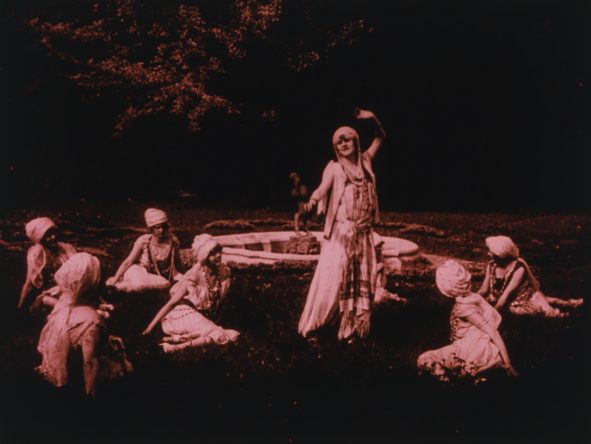
Watch online
The unique nitrate print of Enis Aldjelis was discovered in the Netherlands in the 1980s and repatriated to Austria in 1991, where it was restored by Filmarchiv Austria and recently digitised. As the original screenplay no longer exists, the Austrian Film Archive created new German title cards for the restoration, based on the Dutch intertitles on the nitrate print. The score is by Istanbul-based psychedelic band BaBa ZuLa and was recorded live during a performance on 30 April 2025 in Istanbul. You can watch it for free on our streaming platform Eye Film Player.