
Béla Tarr (1955–2026) is widely regarded as the most influential film auteur of the past forty years. He made monumental, earthy films in which he portrayed humanity in the bleakness of its existence. And yet there is sometimes a fleeting glimpse of redemption: when the drink flows, a small band strikes up, and bar patrons lose themselves in a drunken dance. Tarr shows us existence stripped of all ornament and invites us to respond with compassion.
Tarr would sometimes joke that Kodak’s standard eleven-minute reel of film amounted to a form of censorship. This was hardly an exaggerated remark from a man whose films can run to more than seven hours, such as his overwhelming apocalyptic vision Sátántangó (1994). Narrative plays a subordinate role in his work; it is the images – shot in black and white – that do the heavy lifting, while sound design and music carry his parables of humanity as a bundle of existential despair.
In Memoriam Béla Tarr: the master of the hypnotic long take
The Hungarian director Béla Tarr died on 6 January at the age of 70. This extraordinary filmmaker shaped his melancholic, pessimistic worldview in highly stylised black-and-white narratives, carried by long takes, earning him the title of master of the hypnotic long shot. In its cinemas, Eye is screening Damnation, The Turin Horse and Sátántangó, and The Man from London with an introduction by Tilda Swinton. Five of his masterpieces can also be watched on Eye Film Player, including the trilogy Damnation (1988), Sátántangó (1994) and Werckmeister Harmóniák (2000). In 2017, Eye presented the exhibition Béla Tarr – Till the End of the World.
By Mariska Graveland08 January 2026

© Babette Meyer
The animal within humanity
Tarr’s hypnotic films are tales of civilisations on the brink of collapse. Damnation (1988), together with Sátántangó (1994) and Werckmeister harmóniák (2000), forms a trilogy created in collaboration with the Hungarian novelist and Nobel Prize laureate László Krasznahorkai. All three films can be read as commentaries on the fragility of human civilisation: unexpected, threatening developments bring the animal instincts in humans to the surface and swiftly erode solidarity within a close-knit community. Loneliness, rain, alcohol-soaked cafés and human despair: Tarr captures it all in spellbinding black-and-white images.
Sátántangó is Béla Tarr’s seven-and-a-half-hour magnum opus about the inhabitants of a Hungarian village in the aftermath of the fall of communism. It seems almost impossible: spending an entire working day in a cinema seat, watching a single film. Yet this is precisely what Tarr asks of his audience – and that this poses no problem was proven by the rapturous responses from both audiences and critics upon the film’s release in 1994 and at subsequent re-screenings. Drinks – lots of drinks – and rumours that the dead have risen take hold of the villagers’ imaginations in Sátántangó.
The end of days
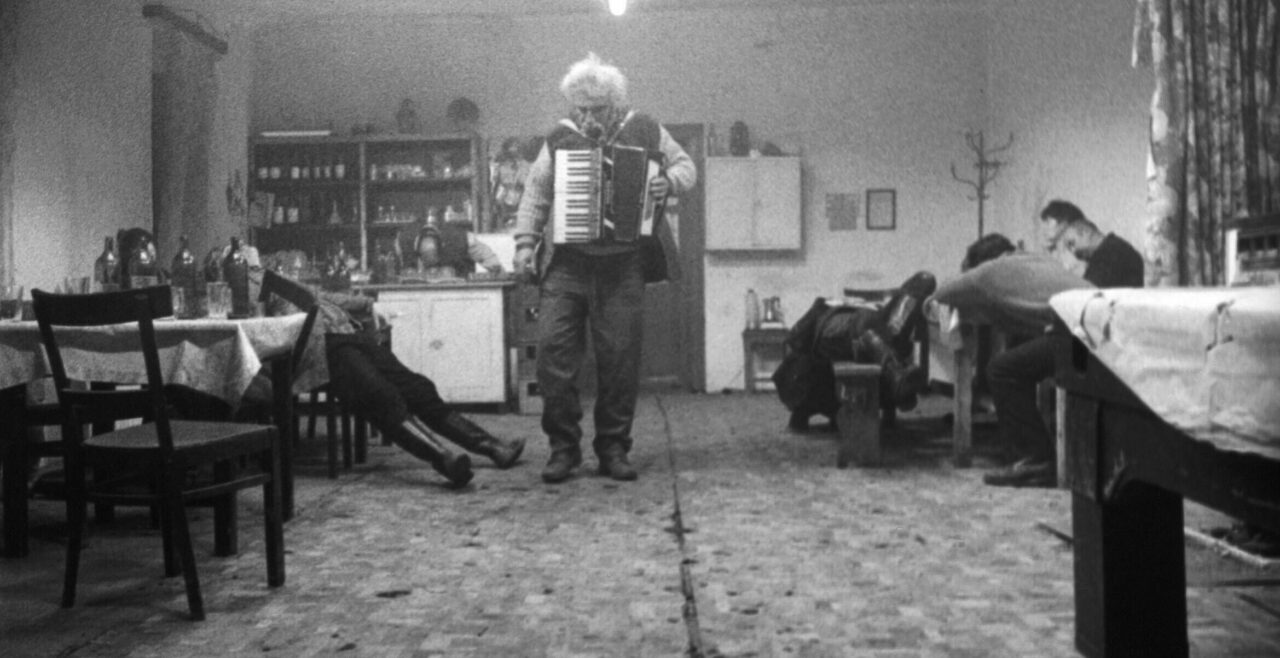
With Damnation, too, Tarr created an elusive, melancholic film about the impending end of communism. This existential film noir parable attains an almost abstract beauty amid rain, mud and howling dogs.
The Turin Horse is a monumental tale of what might be described as the end of days. Tarr took as his point of departure the anecdote of Nietzsche’s mental collapse in Turin. This hypnotic parable about the trials of human existence – shot in just thirty takes – is an ostensibly simple record of a week in the life of the farmer and pálinka distiller Ohlsdorfer. Father and daughter go about their routines, boil a potato and listen to the storm sweeping across a barren plain on which only a single tree stands.
After receiving the Silver Bear at the Berlin International Film Festival, the director announced that The Turin Horse would be his final film. Tarr said: “I believe that everything that can and must be shown in a film has been brought together in The Turin Horse. In other words, I have used all the possibilities of film language.”
Tarr regarded The Turin Horse as a film about the end of the world and, at the same time, as the end of his own filmography. He could not imagine ever making another film that would be even more stripped back, even more reduced to its essence. Since then, Tarr has run a film school in Sarajevo.

still Damnation (Béla Tarr, HU 1988)
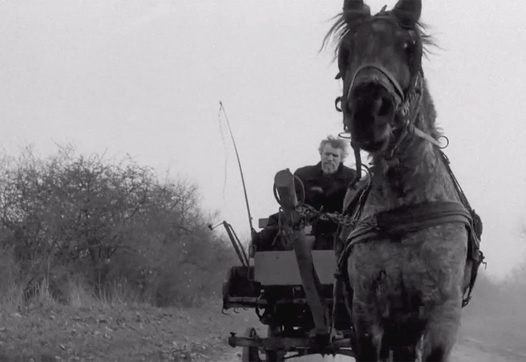
still The Turin Horse (Béla Tarr, HU/FR/CH/DE 2011)
Lifted out of misery
Béla Tarr began making films at the age of sixteen, mostly naturalistic and socially engaged dramas and documentaries. After studying at the Budapest Academy of Film, he went on to develop an idiosyncratic and highly influential style of his own.
The director is renowned for his love of extended narration, pushing the possibilities of film language to their limits. Few filmmakers have dared, as Tarr did, to place such complete trust in the image – an image that lifts you out of misery. Since Damnation, he has worked exclusively in black and white, or rather in shades of grey, employing extremely long takes in which the camera slowly ‘explores’ a space or a landscape.
I still don’t see film as show business, but as the seventh art. I’ve never been interested in stories, because stories are always the same. Just read the Old Testament, it’s all already there. We have no new stories to tell; we always end up in the same old one.
Béla Tarr
Eye has long followed the work of the internationally acclaimed director, whose films have regularly been shown in the Netherlands. The film museum released two of Béla Tarr’s films – Werckmeister harmóniák and The Turin Horse – and holds around twenty of his titles in its collection, including early short films and co-productions with Hungarian television.

© Babette Meyer

© Babette Meyer
IN PRAISE OF DARKNESS
Fred Kelemen, 22 October 2025
The novels and stories of László Krasznahorkai, as well as the films of Béla Tarr and my own, have been called “dark,” even “gloomy.” They are not gloomy, they shine, and their darkness allows us to see. They lead into a depth behind, beneath, above, or within the very surface that is overlaid with its dazzlingly bright reflections and blinding glimmers, concealing what is hidden and kept silent, especially by those who want us to believe that everything is fine, that is, for our “own good”, in order to distract us from their true intentions.
In these times of hypocritical moralists, deceitful prophets, exploitative saviours and deadly ideologies, it is necessary to dare to go beyond the dazzling lights, beyond the dizzying spectacle, with its deafening drum rolls, to enter the clear, quiet darkness that opens to us, where the reward of patience is the image of man slowly revealed to the eye and the beating of his heart slowly heard - in his wounds, his fear, his despair, his fragility, his longing, his beauty, his audacity and his creativity.
Praise to the benevolent darkness, which heals the inflamed gaze and allows to see.