Skip to content

Films as weapons: the rediscovered archive of Leonard Henny

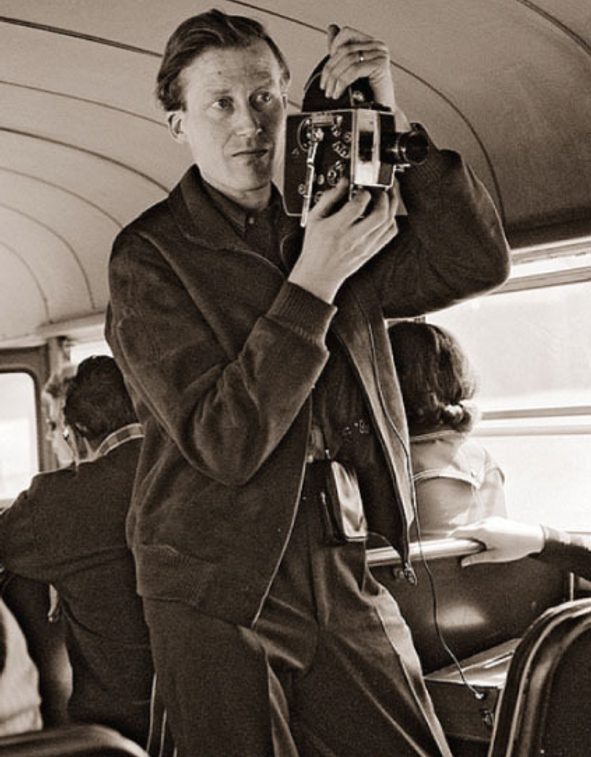
He left the office at lunchtime, changed out of his suit in a gas station toilet, and walked into a cloud of tear gas with a wind-up Bolex camera and a gas mask. By afternoon he was back at his desk at the Stanford Research Institute. Leonard Henny – Dutch sociologist, Fulbright scholar, and, as it turned out, guerrilla filmmaker – spent the second half of the 1960s living this double life. The gas mask is now part of Eye's collection. In May 2026, curator Simona Monizza and film historian Nico de Klerk told Henny's story at the Eye International Conference, drawing on his personal archive, recently deposited at Eye by his family, together with material from American collections and Dutch archives. This is that story.

By Simona Monizza & Nico de Klerk03 November 2026

Leonard Henny filmt een anti-Vietnamprotest, met gasmasker en opwindbare Bolex-camera, eind jaren zestig. Beeld uit de Eye-collectie, geschonken door de familie Henny.

From assimilation to the 'American Dilemma'

In 1967, sociologist and activist filmmaker Leonard Henny wrote: “Despite its immense technical capacity and material wealth, the ‘American Dilemma’ is still a real social concern. Although it is a country with the greatest influence on the future of the world, and a government that speaks of world peace and economic development, it pursues a policy of total war. To what extent do sociologists have an answer to the core problem of sociology: how to build, or rebuild, a society that fails to live up to its own norms?”

As a student in Amsterdam in the late 1950s and early 1960s, Henny immersed himself in American assimilation sociology: the idea that minority groups get ahead by adopting the host society’s customs, language and attitudes. In 1963 he moved to the United States on a Fulbright Fellowship with his wife, Mariëtta, to study urban sociology at the Massachusetts Institute of Technology (MIT). Five years later, in an interview with a Dutch newspaper, he admitted it had taken him a while to see that American society was not an open competition. His understanding, he said, had been "book-learned" rather than lived.

It was lived experience that changed his mind. In the summer of 1964, Henny spent four months in the jungle of southern Venezuela, working for Harvard and MIT's Joint Center for Urban Studies on the planning of a new city, Ciudad Guayana. He was responsible for the educational side of the project. Out on the streets, he saw what American-style urban renewal often meant in practice: Black neighbourhoods demolished with no alternative housing offered in return.
A freedom school in Alabama

The real turning point came in August 1965, when Henny volunteered as a so-called freedom teacher. Freedom schools had been set up by civil rights organisations to offer a real education in the underfunded, segregated schools of the American South – schools that, more than a decade after the Supreme Court outlawed racial segregation in education, still operated exactly as before. For a few weeks, in the small town of Eutaw, Alabama, Henny taught mathematics and French to Black children aged twelve to eighteen, in what he called a rickety building that passed for a school.

He wrote to Mariëtta: "You had the most brilliant idea that I bring chalks and pencils. You can't buy anything in this town […]. There is one warped blackboard made of cardboard, no schoolbooks, no wallcharts, it's a miracle they ever learned anything. Yesterday, I drew a map of Europe with one of your chalks. The youngest children didn't know what a map was. But when you explain it they are quick on the uptake."

It was during these weeks that the aforementioned American dilemma revealed itself most starkly: during his stay, two students and a cleric doing similar volunteer work in a nearby town were murdered by the Ku Klux Klan. More than anything he ever learned from books, this experience drove Henny into the protest movement, and into the struggle against racial injustice and the Vietnam War.

Becoming a guerrilla filmmaker

After graduating from MIT in February 1967, Henny joined the Stanford Research Institute (SRI) in Palo Alto, California: an institute largely funded by government and industry research contracts. His first assignment sent him, with his wife and baby daughter, to Saipan in Micronesia: another education project, this time for an administration intent on phasing out Indigenous languages in local schools in favour of an American curriculum. Henny called the plan "imperialist". It also served a strategic purpose: the American military had a large base nearby, on Guam, from which bombers flew to Vietnam.

Back in California, Henny was not involved in the defence research SRI carried out for the Pentagon. In his own time, though, he threw himself into the anti-Vietnam movement, filming demonstrations and draft resisters on 16mm – hence the lunch-hour costume change, the gas mask, and the Bolex now kept in Eye's collection.

Henny made sixteen films in his lifetime, most of them in this short, intense period between the late 1960s and early 1970s, all while raising a family and working as a researcher.

Henny filmt met zijn Bolex-camera. Beeld uit de Eye-collectie, geschonken door de familie Henny.

He described his method and motivation in a 1970 article for the journal 'Critical Sociology', Films as Weapons in the Struggle to Liberate the American Mind: "A new Society is emerging from within the old. In the struggle of liberation […] the Underground Press is taking on the battle with the newspaper consortia, and guerrilla filmmakers are shooting counter-productions." In a 1968 interview during a visit to the Netherlands, he put it more plainly: "The only sensible war is the war against the war. The weapons in a war against war are varied. One is the Underground Press, the other is Film." His own weapons, he said, were "a wind-up Bolex camera, and a gas mask to withstand the teargas of the charging police."

"The only sensible war is the war against the war. The weapons in a war against war are varied. One is the Underground Press, the other is Film."

Leonard Henny

Henny's films share the precariousness of the genre known as guerrilla filmmaking: shot during actual unrest, on no budget, often by people still learning the craft, and distributed through outlets like American Documentary Films and Newsreel, two collectives that supplied counter-information on Vietnam and the liberation movements of Americans of colour. Henny called his own approach "Participatory Documentary": filmmaking in which the director is directly involved with the group whose struggle is on screen. He built alliances across the activist and artistic spectrum, from the Black Panthers and the Committee for Draft Resistance to the Art Ensemble of Chicago and the St. Louis-based Black Artists Group.

Three films, one war

His debut, Peace Pickets Arrested for Disturbing the Peace (1967), captured Stop the Draft Week in Oakland that October, when protesters used their own bodies to block buses carrying draftees into the Induction Center. Folk singer Joan Baez was arrested along with more than 120 fellow demonstrators.

The Resistance
(1968), made with the Peace and Liberation Commune and the Committee for Draft Resistance in the San Francisco Bay Area, centred on David Harris, the charismatic face of the anti-draft Resistance movement, sentenced to three years in prison that May. Henny edited the film in Waddinxveen, in the Netherlands, with Kees Hin. A truck fitted with a projection screen and sound system then carried it across the United States for the summer of 1968, spreading word of the Resistance movement to audiences who had never seen it.

still Peace Pickets Arrested For Disturbing The Peace (Leonard M. Henny)

still Peace Pickets Arrested For Disturbing The Peace (Leonard M. Henny)

still The Resistance (Leonard Henny, US 1968)

But What Do We Do? (1968) turned Henny's camera on people he knew personally: colleagues at SRI working on weapons systems for Vietnam. The film was part of a larger research project with sociologist Jeffrey Schevitz that also produced the book 'The Weaponsmakers' and the film The Schizophrenia of Working for War (1969), the shared subject being the conflict of working for a war one opposes. But What Do We Do? follows one of three case studies from that research: the "Drop Out," an engineer who quits the defence industry for an alternative way of life. The film was sponsored by the Technology and Society Committee (TASC), a group Henny co-founded at SRI to explore non-military work for scientists, which grew into a wider scientists' action group.

An archive run from the living room

In January 1970, Henny began turning a one-person habit into an institution: Films for Social Change (FSC), a small but determined distribution collective built to support not only his own films but dozens of other radical filmmakers who could find no other outlet. "We at FSC feel that these films should be made available regardless if there is a market for them or not," he wrote in a promotional flyer. "Our films are made not for profit. They are made to be seen! And to be discussed!"

"Our films are made not for profit. They are made to be seen! And to be discussed!"

Leonard Henny on Films for Social Change

Het oudst teruggevonden spoor van Films for Social Change: een statusbrief aan Canyon Cinema Cooperative, 25 januari 1970. Collectie Film Makers Coop, New York.

FSC ran out of Henny's own home from 1970 onward. He wrote and mailed letters and brochures to peace groups, student organisations, film libraries and churches, and shipped out film prints himself to fulfil bookings, while also placing prints with larger distribution collectives such as Canyon Cinema in California and the Film-Makers' Cooperative in New York.

De Media Truck, St. Louis, 1970. Courtesy Department of Special Collections, Stanford University Libraries.

In St. Louis, where Henny taught, he folded his students at Washington University into the operation through a project called the Media Truck: a vehicle fitted with slide and film projectors, built to "bridge the communication gap" between campus and suburbs, screening footage of David Harris and the Resistance movement wherever it parked.

In 1970 and 1971, FSC scaled up fast: radio spots, advertisements in radical papers like 'Ramparts' and the 'Liberation Press', and a growing catalogue. By March 1971 that catalogue listed 25 titles by 13 filmmakers, organised into themes – On Black Liberation, On the Draft, On Social Responsibility, On the Emerging Counterculture – with a "speakers bureau" of people available to introduce screenings and lead discussions, a model not unlike Amsterdam's own Cineclub.

Omslag van een vroege Films for Social Change-catalogus, ‘The Creation of a New Consciousness’. Collectie Eye Filmmuseum.

Crossing the Atlantic

In 1971, what began as a planned leave of absence to set up a European branch of FSC in Amsterdam, became a permanent return. Henny handed the American operation in St. Louis to its founding members and took up a post at the Sociological Institute of the University of Utrecht, where he would go on to make films with his own students.

In the Netherlands he picked up a thread from 1968: his contact with Jan de Vaal, the first director of the Nederlands Filmmuseum (the institution now known as Eye Filmmuseum), who admired Henny's enterprise. That cooperation led, in 1970, to the acquisition of three of Henny's films: Black Power, But What Do We Do? and The Schizophrenia of Working for War. From Utrecht, Henny kept FSC running, forging ties with Dutch distributors of alternative film such as Fugitive Cinema and various cineclubs, and growing the catalogue to around 50 titles.

By 1974, FSC's American office had closed and no one had stepped in to run it. A chance meeting that June, at the First International Encounter for a New Cinema in Montreal, changed that: American filmmaker Peter Rubin agreed to set up a new FSC branch in New York. Decades later, in 2016, Rubin's own collection was deposited in Eye's archive – a connection Simona Monizza's team only recently uncovered, and one they hope to trace further.

Preserving a damaged, radical archive

The research and preservation project that Monizza and de Klerk presented in May is itself a story of international collaboration. Canyon Cinema, the Pacific Film Archive and the Film-Makers' Cooperative in New York all helped trace Henny's scattered distribution prints back to his family, who then deposited the material at Eye. No camera originals have yet surfaced, so the preservation work starts from prints that are often heavily scratched, dirty, or discoloured – prints that carry the marks of decades spent travelling from cineclub to campus to church basement. Eye's approach has been to preserve that history rather than erase it, focusing restoration on sound and colour grading. Three American titles have been preserved so far, with two more planned in the coming years. The plan is to bring this largely unknown chapter of radical film history to wider audiences through articles, cinema programmes, and Eye Film Player.