
On her way to the recording studio to lay down the 'hopefully final' voice-over for her newest production, Merel Westrik settles onto a sunny terrace in Amsterdam-Oost to talk about the film. Not many animals will pass by, save for one brazen house sparrow, but her stories are peppered with species. Her enthusiasm for urban wildlife is so infectious that you almost expect to encounter a pine marten in passing.
When a reference comes up about a social media trend in which people in their thirties sheepishly admit to having suddenly developed a love of birds, she looks back blankly. But the moment she starts talking about the lapwing or the chiffchaff, her eyes light up.
Merel Westrik on Amsterdam Wildlife by Night
More than ten years after Amsterdam Wildlife, urban ecologist Martin Melchers and filmmaker/journalist Merel Westrik return with a nocturnal follow-up bearing the striking title Amsterdam Wildlife by Night. The first film screened continuously at Eye Filmmuseum for more than three years and attracted over 14,000 visitors, earning it official Crystal Status. Amsterdam Wildlife by Night will screen exclusively at Eye from 5 June onwards. More than enough reason to put Merel Westrik under the spotlight and talk about Amsterdam’s urban wildlife.
By Sarah Famke Oortgijsen02 June 2026
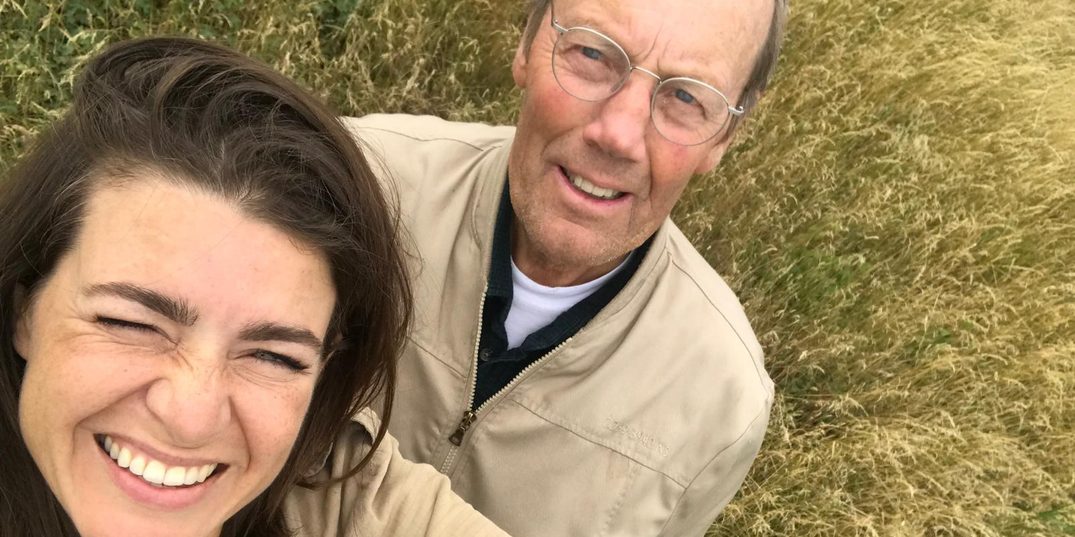
Merel Westrik en Martin Melchers
Where does your love of (urban) nature come from?
"I grew up in a ribbon village in Westzaan. I had a wonderful childhood there, and I think that's why I'm still happiest surrounded by meadows and fields. I spent endless hours running through wild meadows full of buttercups, fritillaries, cuckoo flowers and, if you looked carefully, even sundew. We spotted black-tailed godwits and hunted for lapwing nests and baby hares. My mother also had shelves full of books with large illustrations of all kinds of plant and insect species. That apparently leaves an imprint on your brain that never goes away. She always named the different species too. If I said 'look mum, a yellow flower!' she'd never just say 'yes, indeed' – it would be 'yes, that's a buttercup' or 'that's coltsfoot'. If you have happy memories tied to that, it stays with you."
That sounds more like countryside than city.
“When I was around twenty I moved to Amsterdam and started working at local broadcaster AT5. That's where I met Martin Melchers, who worked for the city as an urban ecologist. One day he called with the news that the first lapwing egg in Amsterdam had been found. I burst out laughing: did we actually have those in Amsterdam? 'You bet,' he said, so I asked if I could make a report about it."
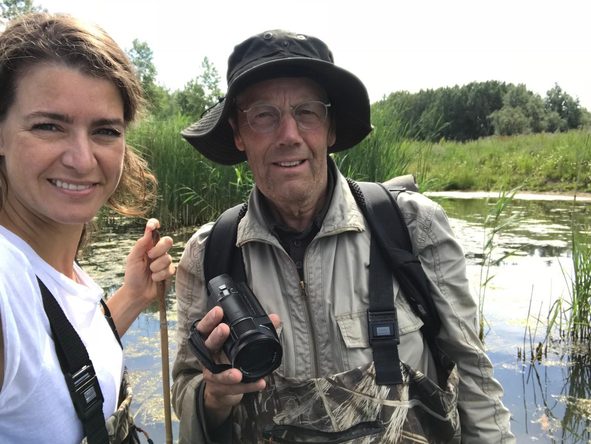
Merel Westrik en Martin Melchers
And so it happened. For the first time in years, Merel pulled on her boots and headed out into the landscape of her youth, only this time it was Amsterdam's harbour area. "It triggered something in my head, it opened a hatch to the past. I remembered how much fun I'd always had."
It was the first of many reports they would go on to make together. "After that I tried to claim Martin. If a dead eagle owl was brought in to the animal ambulance, we'd go and find out how it got there."
There is no shortage of anecdotes from her time with Martin at AT5, from a fox den discovered in the harbour area ("A site hut was being moved, and the cubs were underneath it") to a hare that simply wandered into a shoe shop on the Nieuwendijk ("Probably fled the loud music from a festival in the Westerpark and then lost its bearings").
Was that when things really got going with Martin?
"Martin has a fantastic way of talking about animals. Take the story of the eel in Amsterdam. They swim all the way from the Sargasso Sea as glass eels and find their way into our inland waters through the pumping station, guided entirely by their sense of smell. And then Martin says: 'Merel, those eels have seen things we've never seen. Orcas, blue whales, dolphins…' It's such a wonderful way of looking at things. Always from the animal's perspective, and always with humour."
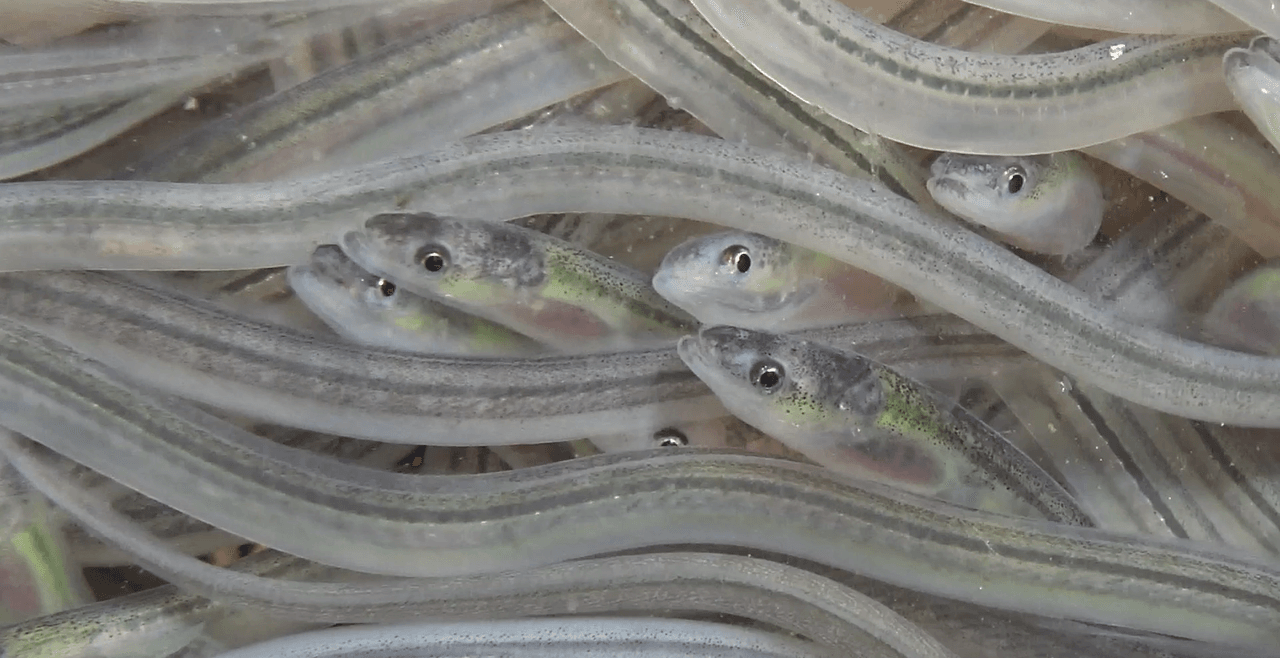
Glasaaltjes
That combination of knowledge and humour is exactly why she never let him go. The collaboration has now lasted twenty-five years, and the films are a direct product of it. "It's also a bit of an ode to our friendship. Martin is a true specialist. He knows how hares move, thinks like a hedgehog, knows how a ring-necked parakeet or an owl behaves. You need people like that in your city – and in your life – to show you how extraordinary everything really is. We really want to share that, without forcing it down people's throats."
While Martin takes on the role of urban ecologist in the films, Merel is the (not so) silent force behind the productions. She has done much of the filming herself, co-edited, handled the invitations, produced the subtitles, including an English version, and found someone to design the poster. "I have absolutely no idea how the film world works. It's a hobby that got out of hand," she says with obvious affection.
Amsterdam Wildlife ended up running continuously at Eye for three years. Did you expect that kind of success?
"Amsterdam Wildlife started as our passion project. We asked people to buy a symbolic ticket in advance, and used the proceeds to make a cinema version and hire out Tuschinski. By chance, someone there said: 'This film is too good to only show once.' She put us in touch with one of your programmers."
What do you think explains the success that followed?
"As an Amsterdammer, I think: I'm also interested in who I share my city with, whether that's people or animals. If you're a curious Amsterdammer, it's just really wonderful to know what's out there watching alongside you. What lives in the Amsterdamse Bos where you go running or walk your dog every week."
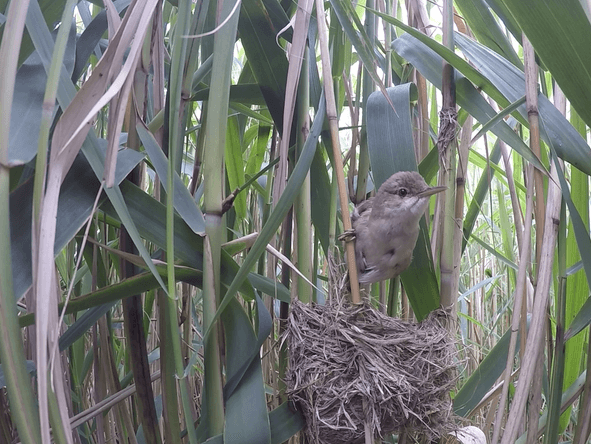
Een karekiet in diens nest in het riet
"The sedge warbler is everywhere in the reed beds – you just have to know that. But once you do know, and you hear one, you'll always know what it is from that moment on."
"Just as you can enjoy Amsterdam's human birds of paradise [its famously flamboyant residents], you can enjoy all the remarkable animals too. I find that mind boggling."
Amsterdam is also a particularly good place for it, she adds. The city sits at a crossroads of landscapes. "From a high point you can see the sea, the dunes and the inland waterways. We're surrounded as a city by a vast green area." That draws in species you wouldn't expect to find in just any other city. "But even – and especially – in the harbour area, right in the thick of shipping traffic and loading and unloading, many species make their home."
At some point there was also the documentary De Wilde Stad [The Wild City], which covered – literally and figuratively – the same territory. How did you feel about that?
"Our baby fox is their adult fox. We made our film in 2015, three years later De Wilde Stad came out. I say: the more nature films the better! We actually helped the makers: we knew where to find a particular duck's nest on a high balcony. When the ducklings leave the nest, they just jump straight down. It's spectacular to film, but we only had a handycam and a couple of GoPros. They had a large professional production team, with camera operators from National Geographic. So we happily passed those shots on to them. You can never have too many films like that."
More than ten years later, here is Amsterdam Wildlife by Night. Why did it take so long?
"After part one we actually started on part two straight away, with great enthusiasm. But then life got in the way." She lists it all with the lightness of someone who has long made peace with it: an editor with a broken back, herself busy with the morning news programme, a move, renovations, the intense early years with a young child. "And the filming window is just very narrow, we always needed spring. If something goes wrong, you've immediately lost a year. So the footage spans several years, but you can't really tell."
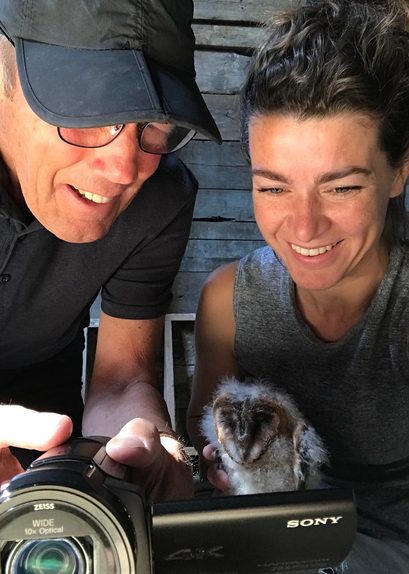
Martin Melchers en Merel Westrik
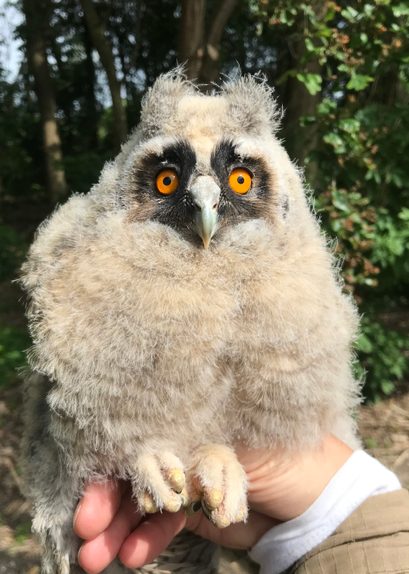
Ransuiltje
Why did you want to make a sequel at all?
"There were still so many species we hadn't managed to include in the first film. We hadn't captured all the mustelids yet, there were no owls in part one. It was almost immediately clear that we wanted to make a second part, to be more complete, even though you never fully are. The subtitle is about the hidden nature of Amsterdam. That's mostly about nocturnal species. You don't see them during the day, which makes them extra hard to film, but all the more magical. Take the pine marten."
At the mention of this species, something shifts in Merel's manner. She holds out both hands to show how big the animal is: roughly a metre from nose to tail. At home she has a taxidermied specimen, a pine marten that was hit by a car and found in Amsterdam Zuidoost. "When animals are hit by cars it's very sad, but it's also a sign that they're there, in large enough numbers that one occasionally gets run over."
The pine marten was the holy grail of the film, even though Martin had his doubts. They used night cameras and wildlife cameras, and tried to lure the animal with grain. "But of course that only attracted mice and rats. Ha! We must have hundreds of hours of footage of mice. Every time we went back to review the material we had hope, every time it was mice."
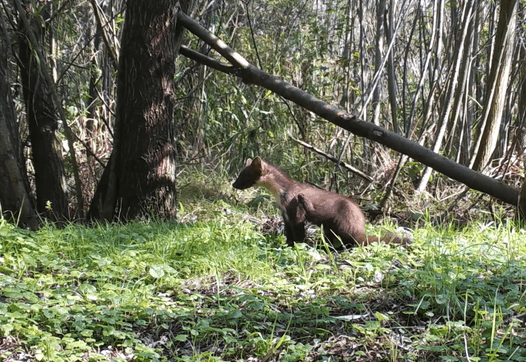
De boommarter bij dag
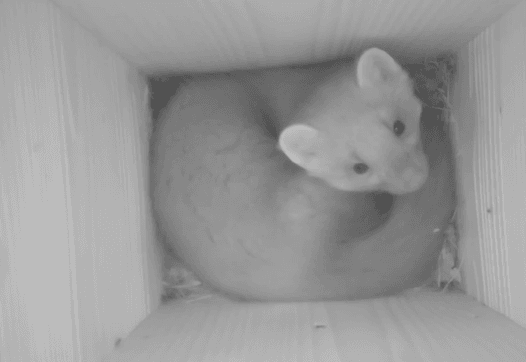
De boommarter bij nacht
Eventually they succeeded, and were even able to film the pine marten during the day. Alongside the pine marten, the stone marten, the stoat, the weasel and the polecat also make appearances, all within the city limits of Amsterdam. And then there is the fox, which could fill a whole film of its own, according to Merel. Foxes regularly wander into the city. "I have… let me call it admiration, no, deep respect, for how these species manage to hold their own in a busy city like Amsterdam."
What makes this film different from the first, apart from the darkness?
"We wanted to focus more on the hidden species this time. The ones you don't easily spot, but which are so wonderful to know about. Take moths. If you smear some sweet rotting fruit on a tree and go out there with a torch in the evening, you might just find the most spectacular moth sitting right there in your own garden. And they're drawn to light because they think there's an even deeper darkness behind it. That's just really lovely to know."
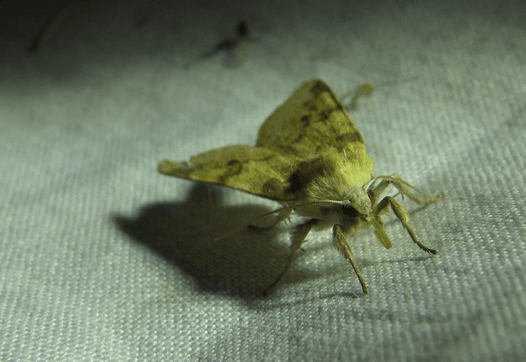
De gele uil, een nachtvlinder uit de familie van de uilen
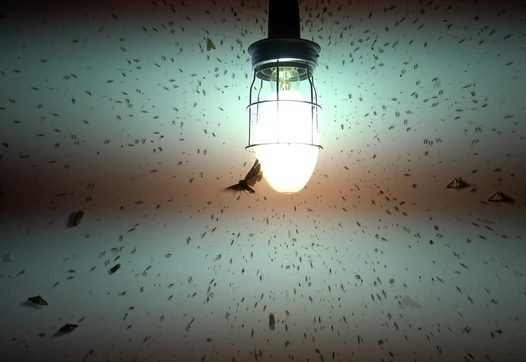
still Amsterdam Wildlife by Night (Merel Westrik & Martin Melchers, NL 2026)
She was completely flabbergasted by it, she says. For the film she went out with field biologist Edo Govers, who researches both mammals and moths in the city. "What you don't realise is that whole clouds of food move through the air at night, through all those back gardens and city parks, wherever there's greenery. And the species you find among them, they're so staggeringly beautiful and large, it's almost too much."
Are there species or shots you weren't able to capture?
"I would have really loved to show how birds of prey and owls spot mice from the air. Mice are somewhat incontinent and leave a trail of urine behind them. Apparently there's a substance in it that birds of prey can detect with their eyes. I wanted to capture that with a drone, but we didn't know how, and we were too small a production for that. We really make this with just the two of us."
When will this film be a success for you?
Merel thinks for a moment, but doesn't hesitate long. "In a way it already is. We've had so much pleasure making this. It's my hobby, I love it, it's where my heart is. And if there are a few Amsterdammers who cycle through the city just a little differently after watching Amsterdam Wildlife by Night, who stop and look for a moment, then that's already wonderful." She laughs. "If everyone spent half an hour a day watching a duck, the world would look completely different. It would really do the world good."