
Carol feels like a perfect vintage Christmas card brought to life. The film is set around the holiday season in the 1950s. In a department store, we watch photographer Therese (Rooney Mara) fall in love with Carol (Cate Blanchett) – at a time when love between women was still an almost unspoken concept in society. It was precisely this that moved director Todd Haynes to bring the story to the screen.
When he read the novel on which Carol is based, The Price of Salt by Patricia Highsmith, he was struck by the fact that it depicted a form of falling in love for which there were no words yet: “There was no language for lesbian desire.” Haynes expresses this through silences, a glance that lingers a second too long, a hand resting on Therese’s shoulder with intention. This desire, set among clicking cigarette cases and muted green light, creates a palpable tension. It is a love story that sends a shiver down your spine.
Fortunately, there are plenty of fluffy coats to keep you warm. For anyone who, like me, has a soft spot for faux-fur couture, this film is pure narcotic. It even makes you yearn for a hat that sits flawlessly atop perfectly styled hair. In that era, decoration clearly did not stop at the Christmas tree; it was present in every aspect of life. Why shouldn’t a streetlamp deserve a little charm? When did we stop giving our surroundings that kind of care? This attention to style, even in the smallest details, makes losing yourself in the film all the more pleasurable.
And yet Carol would stand its ground even in a desolate world. That is thanks to the chemistry between Cate Blanchett and Rooney Mara: it feels as though you are watching two people fall in love in real time. Beyond the romance, this is also a coming-of-age story. With every photograph Therese takes, she seems to discover another part of herself. This process is hindered, however, by Carol’s ex-husband Harge Aird (powerfully played by Kyle Chandler). He embodies how a broken heart can become a weapon, how unchecked jealousy can lead someone into dark places. Still, it becomes clear that speaking your own truth is a force that cannot be extinguished.
Although Carol could have been a political film, it chooses not to be. It is, above all, a powerful love story. And in that, it achieves more than any form of protest ever could. It does not ask for permission; it simply exists. More than that, it takes you back to the sensation of first love, to a time when lying entwined feels like the only logical choice. Carol is the perfect December escape: the soft light, the drifting snowflakes, the freedom to light a cigarette in every scene. It feels worlds away from our present reality, where routines reign supreme. Here, people still dare to drink and flout the rules at night – perhaps precisely in response to the social constraints of the time.
On Rotten Tomatoes, one commenter writes that Carol, while strong, cannot be called a Christmas film. I could not disagree more. No, it is not sugar on sugar, like most Christmas films (and there’s nothing wrong with that – an occasional glucose spike can be delightful). But the fact that a love story is told in full – yes, including its shadows – within a perfect Christmas setting is exactly what makes it the ideal Christmas film. Don’t you think there will be people this year who sit down at the Christmas table with both joy and sorrow?
Of course there will. Carol shows us that we can be grateful for what is present, even while loss sits quietly beside it.
Ode to cinema: Carol
Tess Milne is a writer, programme maker and storyteller with a deep love for film. In her work, she always seeks the human element, whether on television or written in words. For Eye Filmmuseum, she writes the column Ode to Cinema, in which she offers her personal perspective on the magic of film – from childhood memories to unexpected discoveries in the film archive. To mark the tenth anniversary of the modern classic Carol, now showing at Eye, she savours this love story.
By Tess Milne19 December 2025
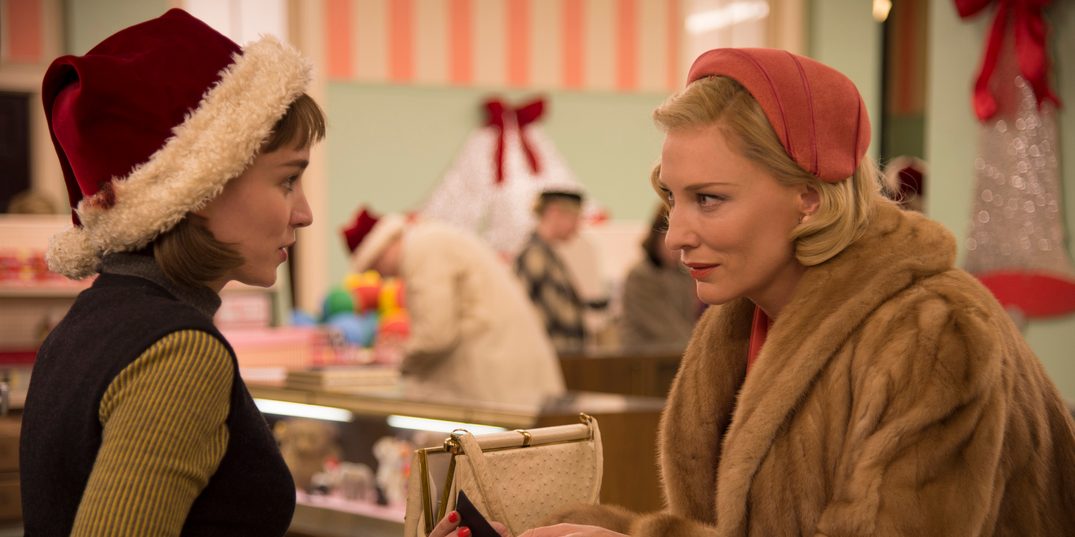
still Carol (Todd Haynes, GB/US 2015)