
What if you were to hear a sound that no one else can hear? An elemental rumble, as if it rose from the earth’s core. A sound so resonant it makes your body quiver. This is what befalls Jessica Holland (Tilda Swinton).
Memoria opens with ten minutes of silence, leaving the audience to wonder whether the screen has frozen. In a world overrun with pixels, this moment evokes the 1990s, when waiting was still a part of life: in a cinema for a late-arriving friend, or in a restaurant while your partner slipped away to the loo. Here, silence lends colour to what remains. In this case, a booming sound that seems to come straight from the source of existence.
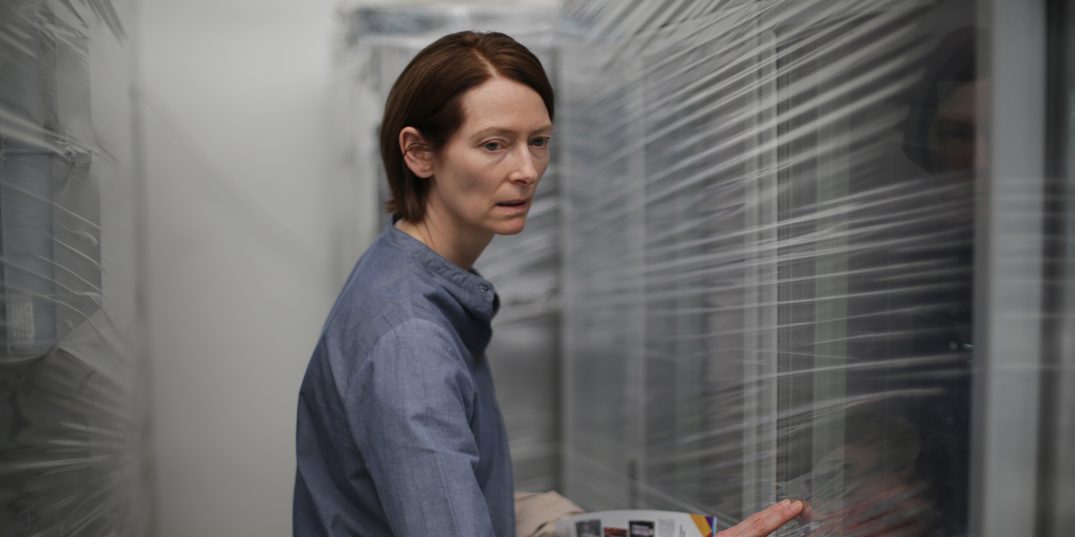
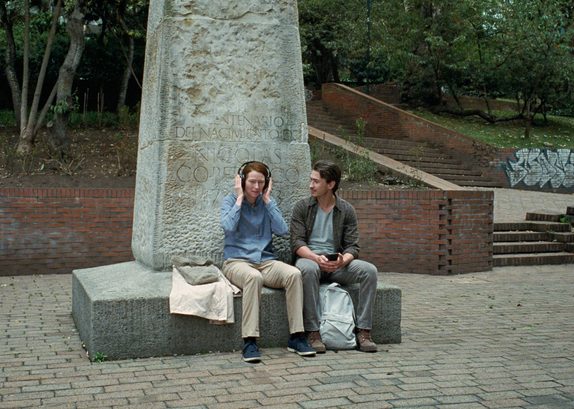
Jessica is a Scottish woman leading a solitary life in Colombia. Her sister lies in hospital for reasons never revealed. She keeps parakeets confined to a cage, and we often see her framed before shuttered windows. These details intensify the sense that she inhabits this world yet never quite belongs to it. As her dread of the sound grows, she seeks the help of sound engineer Hernán Bedoya (Juan Pablo Urrego). She apologises for seeming deranged, while Hernán, with each adjustment on his synths, draws the primordial noise ever closer. The effect is to heighten the film’s mystery, and paradoxically, Hernán emerges as a point of anchorage in a reality that increasingly oscillates between the earthly and the dreamlike. His sudden disappearance feels like slipping through to the other side.
Ode to cinema: Memoria
Tess Milne is a writer, programme maker and storyteller with a deep love for film. In her work, she always seeks the human element, whether on television or written in words. For Eye Filmmuseum, she writes the column Ode to Cinema, in which she offers her personal perspective on the magic of film – from childhood memories to unexpected discoveries in the film archive. Drawing on Apichatpong Weerasethakul’s Memoria (2021), she reflects on how silence lends colour to what is present.
By Tess Milne02 October 2025
still Memoria (Apichatpong Weerasethakul, TH/CO/FR/DE/MX 2021)
still Memoria (Apichatpong Weerasethakul, TH/CO/FR/DE/MX 2021)
Director Apichatpong Weerasethakul is renowned for evoking this sense of the "in-between". Uncle Boonmee Who Can Recall His Past Lives (2010) is a prime example. His own struggles with insomnia – which also led to exploding head syndrome, a condition in which a person hears an extremely loud noise just as they are falling asleep or waking up – are an unmistakable source of inspiration. Add to this the fact that Swinton and Apichatpong deliberately chose to collaborate in a place where both were outsiders, and the result is a cocktail of circumstances that generates an almost alien atmosphere.
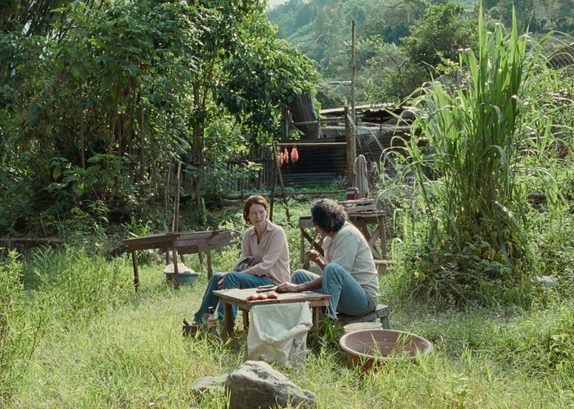
This becomes most apparent when Jessica encounters the older Hernán (Elkin Díaz) in the jungle. She appears almost like a woodland spirit, leaning into the tall grass as she searches for the sound. He, in turn, seems like someone who holds the knowledge of how planets came into being. When she finds him, she sits beside him. He descales fish as the river chatters a gentle song. He tells her that he does not watch films because he remembers everything. We also learn that he never dreams.
still Memoria (Apichatpong Weerasethakul, TH/CO/FR/DE/MX 2021)
“Can you show me?” she asks him. The man without dreams rises, lays himself down in the grass, and dies. At this moment it is difficult not to feel genuinely afraid. It is a particular kind of fear, the kind you only experience just after waking from a disorienting dream, when your waking mind tries to make sense of the sleeping dimension. I imagine that falling into a black hole must feel much the same.
At times, the film recalls 2001: A Space Odyssey, in its exploration of the origins of existence and its reflection on the darker side of humanity. In Memoria, this takes shape through Colombia’s violent past, which Jessica ‘reads’ telepathically through Hernán’s memory. There is also a reference to gorillas, one that quite literally evokes the opening sequence of Stanley Kubrick’s most celebrated work. Yet above all, Memoria is a journey of sound, defined just as much by its absence.
It might be a fascinating experience to experience this film again with one’s eyes closed. For some viewers it will feel too slow, but to them I would say: that is precisely the sensation the world is in such short supply of. It is the silence that lends the events, in this case the primordial sound, so much weight. The fact that Memoria was released during the pandemic makes it almost bittersweet.
As if the isolation we experienced then were trying to tell us something.
And as if we failed to listen.