
During our conversation, all three formats are still being refined. “It’s become a kind of life’s work,” Simone explains. “Normally you don’t spend three years working on a film soundtrack, but for us it’s so much more than that. It’s a journey through Italy, through archives that usually remain closed, it’s about meeting people.”
Nicolò adds: “Fortunately, Eye gave us the freedom to take our time with the project. We travelled to Italy by train several times to do research. We hadn’t even been to all the places shown in the film ourselves. Travelling by train is more sustainable, but it also has its limitations. We constantly had to think about what equipment to bring with us. That only fuelled the creative process.”
Simone continues: “We also had to rely on our network, thinking about who we knew and whether they might be able to help us. Sustainable travel doesn’t just take time, it also costs money. That’s why we mostly stayed with friends and people we’d met in the past, for example after a performance or at a festival. This project has given us a great deal. Watching the footage made us realise how much Italy has changed, which encouraged us to travel more sustainably. The first time we entered Italy by train, it immediately felt right.”
Postcards from Italy: a musical journey through Italy
For the film Postcards from Italy, Duo Bottasso created the soundtrack to century-old travelogues: short silent films intended to offer a glimpse into the sometimes romanticised life of places that at the time still seemed out of reach. Combined with traditional folk music, electronics, field recordings and archival material, the images form a synergetic frame of reference for contemporary understanding. Journalist Michael Oudman spoke to the brothers about the project.
By Michael Oudman11 December 2025
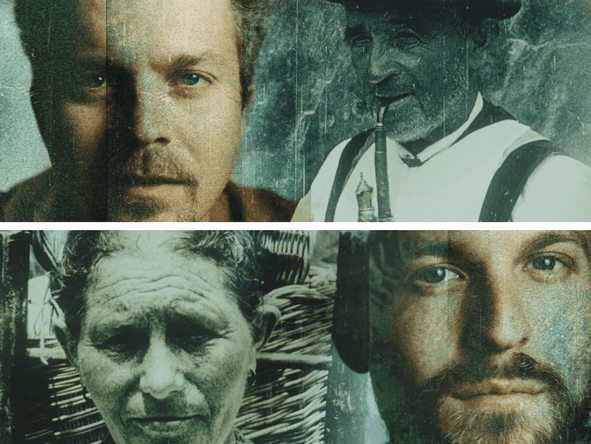
Brothers Nicolò and Simone Bottasso – originally from Piedmont in northern Italy, but now based in Rotterdam – did not take lightly the request put to them by Eye collections specialist Elif Rongen-Kaynakçi. The duo have been working on the project for three years, which will culminate in a live performance, an album and a compilation film in which the restored images are shown in sequence.
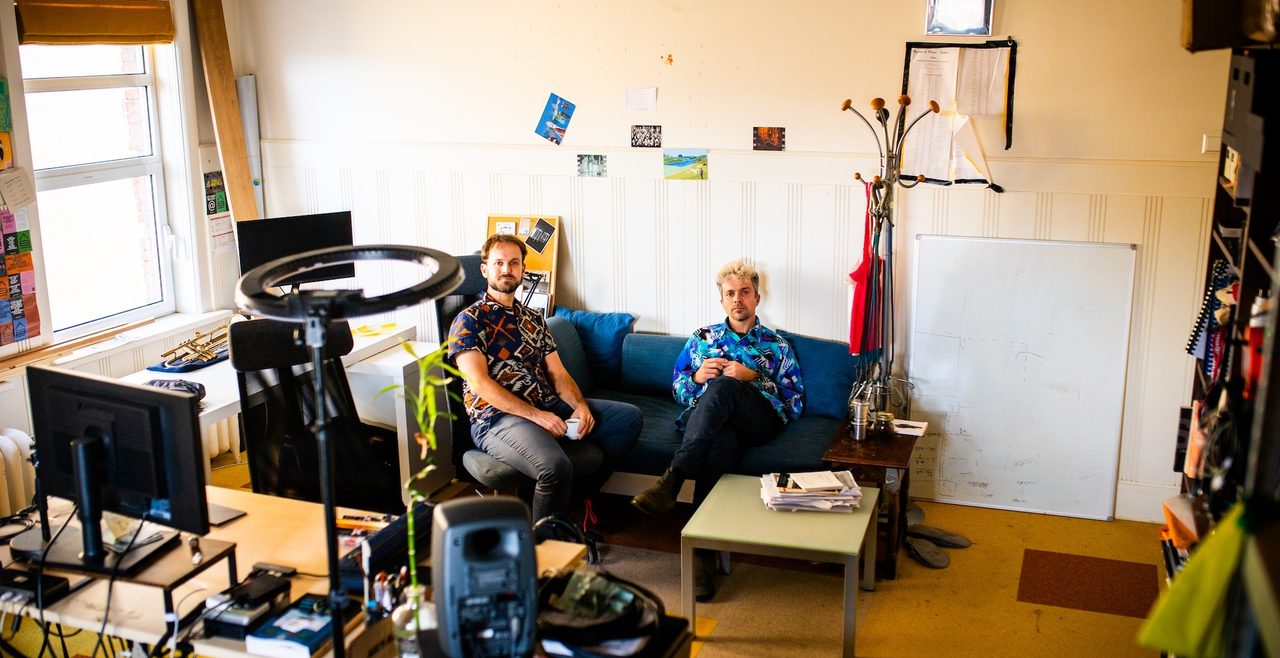
Duo Bottasso (© Michael Oudman)
After three years of research, improvisation and writing, the travelogues have well and truly got under the brothers’ skin. “There are still new things to discover every time we watch the film. There are an incredible number of stories you can tell with this material.” Nicolò adds: “While watching the films over and over, we often listened to music by other artists to feel out what works in which way with the images.” Simone continues: “Eventually we started improvising while watching. We then combined that with traditional folk music from archives we visited during our travels.” Nicolò: “Those archival pieces ultimately became the starting point for our music.” The duo found these materials at the Istituto Ernesto de Martino in Florence, the Archivio Audiovisivo del Movimento Operaio e Democratico in Rome, and the Centro Regionale Inventario, Catalogazione e Documentazione in Palermo.
In the film, the combination of music from the archives and the duo’s own compositions is interwoven with contemporary field recordings and spoken interviews which, like the music, were stored in various archives the duo visited during their journey.
Simone: “While everything at the Eye Collection Centre is carefully valued and stored in climate-controlled conditions, archives in Italy – despite its immense cultural heritage – have received hardly any funding over the past twenty years. Political choices mean that this heritage is no longer properly valued, and everything is left to gather dust. I wonder whether something like that could also happen in the Netherlands, or whether it might already be happening due to cuts to culture. Without political attention, testimonies from key figures in Italian history are lost – such as those of Camilla Ravera, the first female senator and a champion of women’s rights, who stood alongside Antonio Gramsci during the Turin strikes. Or those of Luigi Nono, the Venetian composer to whom we dedicate the music we made for the Venice footage. The conversations with workers in the salt pans of Trapani, recorded by ethno-anthropologist Orietta Sorgi, would be lost as well.”
In this way, the spoken time portrait of a faltering Italy – paralysed by strikes and protests, the murder of Giacomo Matteotti (one of the earliest anti-fascists and a member of the Socialist Party), the stories of people whose voices were silenced by the rise of an authoritarian system – sits side by side with images from Fiat’s Lingotto factory, which were meant to promote the exact opposite. The music used for this scene captures the ideal of progress with driving, repetitive, percussion-led rhythms.
Postcards from Italy is an account of a journey like those once undertaken by the wealthy. From Lago Maggiore in Piedmont to the Ligurian Sea, and via Florence and the Amalfi Coast on to Sicily, before heading north again, through Venice to South Tyrol. We see unknown villages as well as a still tranquil Venice, people celebrating in Naples, and the now monumental salt pans of Sicily.
“When you hear voices in the film, they come from the region where the images were shot. The accents have to match the images,” Nicolò explains – something of great importance to the brothers, given their Italian roots. Moreover, the soundtrack of a silent film accounts for half of the sensory experience, which only increases the importance of, and the care with which, Duo Bottasso approach their work.
“The lack of an existing narrative means you automatically start inventing your own story alongside the images. But we’re no longer used to that today, everything tends to be spelled out. That was quite emotional,” Simone says. At times this resulted in an audible sense of melancholy, most strongly felt in the fragments about Valle Argentina, a valley close to the region where the brothers grew up. The salt pans, too – where the divide between workers and the bourgeoisie is painfully visible – stirred something. At other moments, the music is infused with joy and optimism, matching the warm, sweet feeling that a journey through an idyll can evoke.
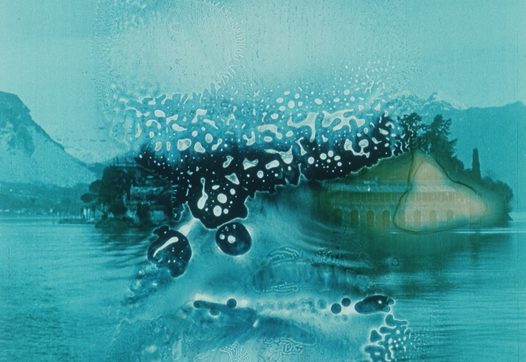
still Postcards from Italy
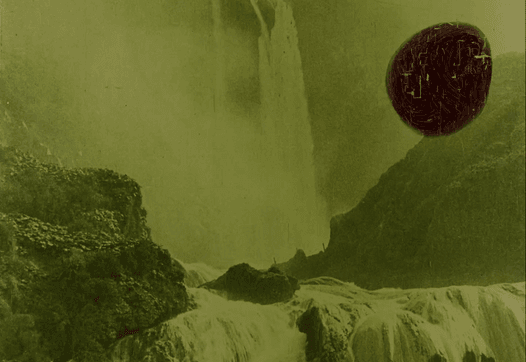
still Postcards from Italy
The inspiration to use voices and field recordings in the score came from 'The Lemon of Pink' by The Books, one of the pieces that was frequently used as musical accompaniment during the first viewing sessions. Nicolò explains: “They were probably among the very best of their time at combining acoustic music with samples and electronics. The album is not only conceptually strong, but also funny. We don’t sing – we’re instrumentalists – so sampling was the way for us to include spoken text as well.” Simone adds, with a smile: “It’s a shame we don’t have a sister who sings.”
Some of the conversations heard in the film were recorded by the brothers themselves. Nicolò: “It obviously helped a lot that we’re Italian ourselves, and that we already had a network. We found it quite easy to strike up conversations with people.” Simone continues: “Sometimes we’d still be talking to someone after a performance, and it would suddenly turn out they were from one of the places featured in the film. We’d immediately switch on the recorder to capture the rest of the conversation.” Nicolò: “In Amalfi, we showed someone the footage of Amalfi to ask whether they recognised the place and knew where it was. At the same time, we took another close look ourselves and realised we were standing in that exact same spot.”
Simone: “People are often very surprised that a film about their small village is apparently held in a Dutch museum. In Sicily we met someone who became deeply emotional when seeing the footage of the salt fields, because her grandfather had worked there. Italians feel a very strong connection to the past.”
And this is where a difference with Dutch culture emerges. Although archives here are accessible, folk songs and traditional culture are approached differently. Simone reflects: “In Italy it really is the music of the people, whereas in the Netherlands it might be seen as conservative. I see both the advantages and disadvantages of innovation and conservatism. Perhaps that tension is what ultimately drives this project.”
Watch online
The result of Postcards from Italy, featuring new music by Duo Bottasso, is now available to stream for free on Eye Film Player.
To Eye Film Player