
‘We leave the film studio for life, for that whirlpool of colliding visible phenomena, where everything is real, where people, tramways, motorcycles, and trains meet and part, where each bus follows its route, where cars scurry about their business, where smiles, tears, deaths, and taxes do not obey the director’s megaphone…’
– Dziga Vertov, diary entry 20 March 1927 (from ‘Kino Eye’ by Annette Michelson, Pluto Press, 1984)
Reconstructing the original music for Man with a Movie Camera
Dziga Vertov's Man with a Movie Camera (1929) is one of the most celebrated films in cinema history, but for decades it was seen without the music intended for its premiere. Researcher Richard Bossons and composer Dr Leo Geyer have spent two years reconstructing the original accompaniment from cue notes discovered in the Vertov archive, tracing forgotten scores and composers to bring the film as close as possible to what audiences heard on that opening night in Moscow in April 1929. The restored film, accompanied by this newly reconstructed score performed by the Constella Orchestra, is available on Eye Film Player. Here, Bossons tells the story of that detective work.
By Richard Bossons18 May 2026
Dziga Vertov’s words anticipate his 1929 experimental masterpiece Man with a Movie Camera which, along with Eisenstein’s Battleship Potemkin, is the most influential of all Soviet films. Acclaimed by many reviewers on its release, and popular with Soviet cinemagoers, the film fell out of favour along with its director in the 1930s and was neglected for decades. It is now a classic of film studies courses and academic papers, influencing filmmakers from Jean Luc Godard to Christopher Nolan and Joe Wright. It was voted one of the ten best films in cinematic history and the best documentary ever made in a British Film Institute poll.
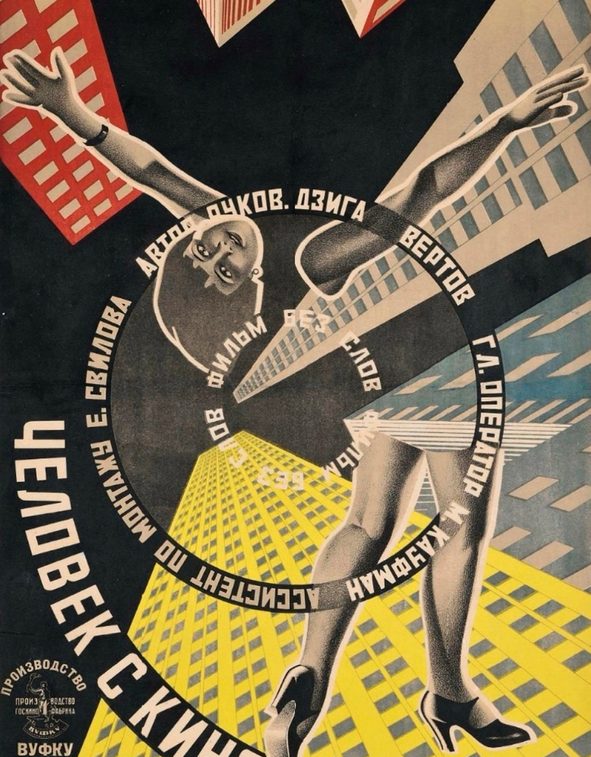
poster Man with a Movie Camera (Chelovek's kinoapparatom) (Dziga Vertov, SU 1929)
The latter title is rather misleading as the film was not meant to be a documentary in the conventional sense. Vertov describes it as an ‘Excerpt from a Camera Operator’s Diary’ in the opening titles, but warns the audience:
Attention Viewers!
This film is an experiment in the cinematic communication of real events
Without the help of intertitles
Without the help of a story
Without the help of theatre
This experimental work aims at creating a truly international language of cinema based on its absolute separation from the language of theatre and literature
Rather than ‘Director’, Vertov describes himself as the ‘Author-Supervisor of the Experiment’.
Produced by the Ukrainian VUFKU film studio and filmed mostly in Kyiv, Odesa, and Moscow, it is superficially about a cameraman’s journey around an unnamed Soviet city observing and recording its inhabitants with his 'camera eye' during one day. However, it is not just a film on city life, a popular theme at that time. The pioneering special effects and rapid montage sequences, the extensive use of different locations edited together to portray a single place, the idea of showing the process of filmmaking, the beautiful cinematography, and its portrayal of humanity, raise the film beyond observational documentary to the level of great art.
A contemporary critic described it as presenting a kind of philosophy of the city rather than a simple record of its daily activities, but above all else it is a celebration of the possibilities of filmmaking. We see the cameraman filming a scene, then the editor at her desk and turntable editing his roll of film, and we then join the audience in a cinema watching the very film that they are a part of. The sophisticated special effects and camera techniques have influenced filmmakers to this day.
The film is structured so that its tempo gradually increases to reach an extraordinary finale at the end, a thrilling montage of chaotic images created by the film’s editor, Elizaveta Svilova. It is actually a very ‘noisy’ silent film, with visual images of machinery, traffic, music, and industrial scenes. The Soviet film scholar Professor Yuri Tsivian wrote that "Man with a Movie Camera invades the territory of sound cinema as far as a silent film can reach." Silent films, though, were seldom watched in silence. From the earliest days there was a musical accompaniment, either by a live orchestra in the large glamorous cinemas, or a pianist or gramophone in the less prosperous ones. Man with a Movie Camera was no exception.
In 1995 Professor Tsivian published, in the October issue of the silent film journal Griffithiana, his translation of two documents that he discovered the previous year in the Vertov archive in the Russian State Archive of Literature and Art, Moscow. One document consists of handwritten notes by Dziga Vertov of a ‘Music Scenario’ for the accompaniment of his film.
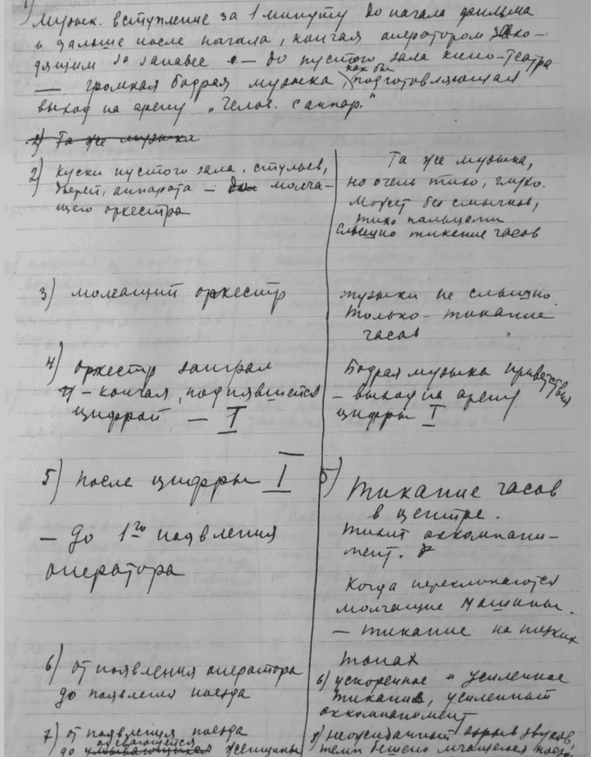
First page of notes by Dziga Vertov for the compilers of a Musical Conspectus. Called a Music Scenario in the archive file, there is no title on the original document apart from that of the film.
The second document comprises a typewritten list of music suggestions known as cue notes or cue sheets, evidently based on Vertov’s notes, compiled by three musicians, well-known as writers on film music technique and cinema orchestra conductors. It is entitled ‘Muzykal’nyy konspekt’ or ‘Musical Conspectus’, which is essentially a structured plan for the musical accompaniment.
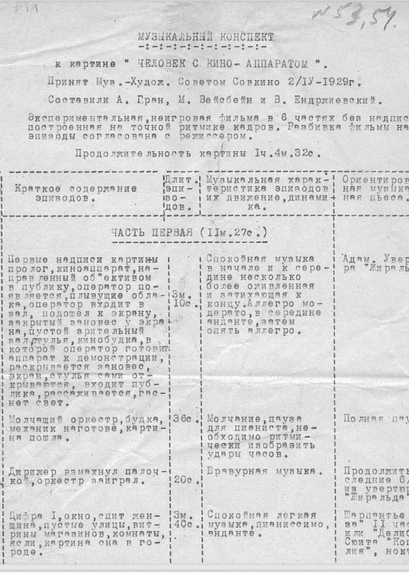
Title page of a Musical Conspectus, cue notes for the orchestras of the Hermitage and Tverskaya 46 cinemas at the premiere and week-long screening of Man with a Movie Camera in April 1929.
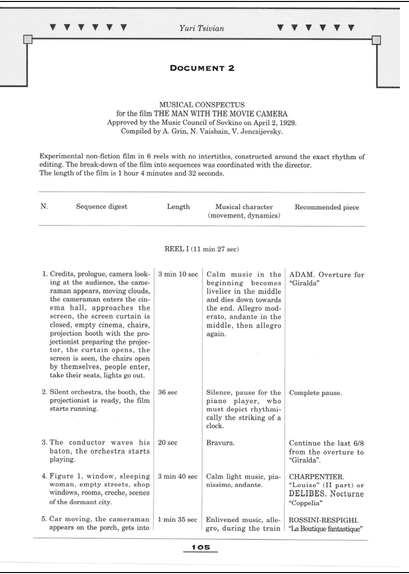
Translation by Professor Yuri Tsivian of the first page of a Musical Conspectus. First published in Griffithiana journal #54, October 1995. Copyright and courtesy of Professor Yuri Tsivian and Cineteca del Friuli.
The state cinema organisation Sovkino approved this document a week before the first screening of the film in Moscow so it was clearly intended for the orchestras in the two cinemas used for the premiere on 9 April 1929, and during the week the film was shown in the city. For these screenings the orchestras would have used the Conspectus to assemble the music to accompany the film. One of the compilers was actually a conductor on the opening night.
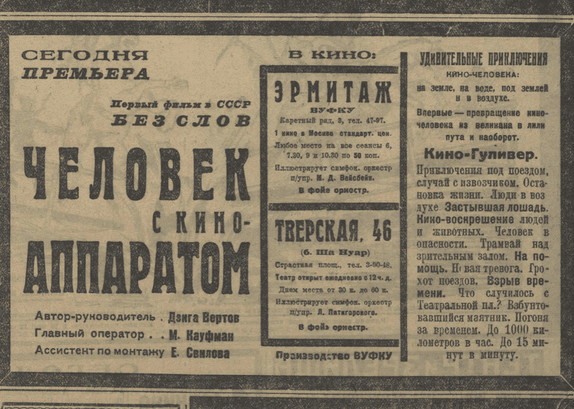
Advertisement on the day of the premiere of Man with a Movie Camera in the Moscow evening newspaper, Verchernyaya Moskva, 9 April 1929.
The Conspectus consists of recommendations for 19th and early 20th Century classical and popular compositions with exact timings and 'mood' suggestions for the film sequences. These cue notes, common during the silent film period, would have been used by the skilled cinema orchestra conductors to arrange an excerpt from the suggested music to suit each film sequence.
The music is surprisingly conventional for an avant-garde film and only loosely relates to Vertov's Music Scenario even though there is a note on the Conspectus that he coordinated the film sequences with the compilers. Vertov also had to organise the accompaniment in haste less than two weeks before the premiere because VUFKU had failed to provide one, and there was no time or money for anything more exciting to suit his cinematic experiment. Despite this, the suggested music generally works well with the film, enabling us to understand and appreciate how Man with a Movie Camera was received at its time.
I collaborated on the two-year project to reconstruct the music from the cue notes with the British composer and conductor Dr Leo Geyer. For authenticity, and to avoid copyright restrictions with commercial recordings, original sheet music was scanned to create digital notation which Dr Geyer used to arrange and compose the music for the 398-page score.
Most of the composers of mainly opera and ballet music, and the occasional foxtrot and waltz, are still familiar, but several are little known today and extensive research and detective work was needed to find the scores for the suggested pieces. This may be the first time in decades that music by Giulio de Micheli, Édouard Trémisot, and Isaac Snoek will be heard.
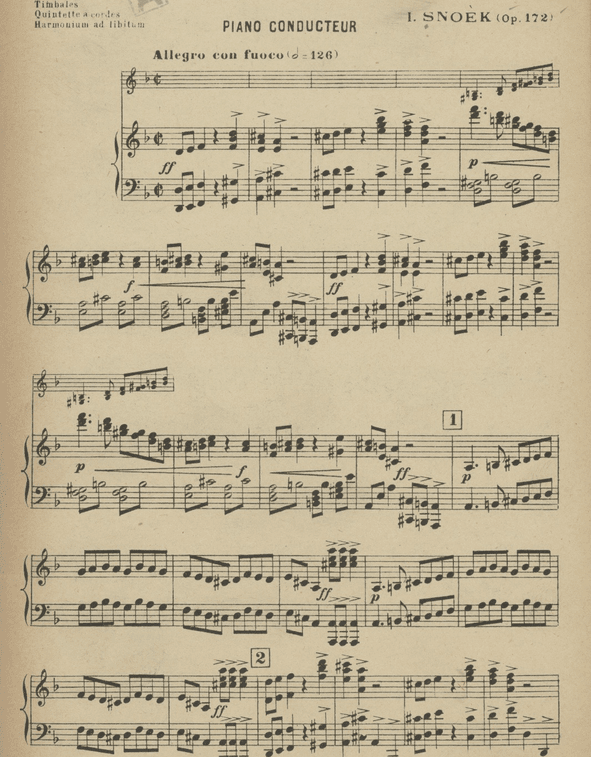
First page of the score for ‘Rivalité’ (Rivalry) by the Dutch composer Isaac Snoek (1870-1943), a prolific composer of light music between the wars, murdered in Auschwitz in 1943. His music has been completely forgotten until now.
In many cases the suggested music was longer than the related film sequence, so some judgement was necessary to select an appropriate excerpt. Some of the compositions were too short and additional music had to be composed in the style of the original.
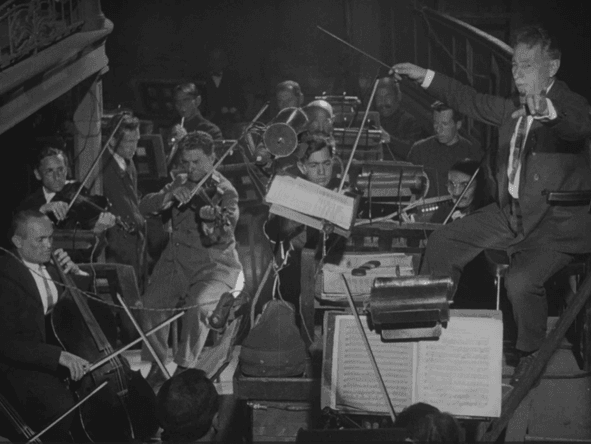
The cinema orchestra seen at the beginning of the film.
All the music needed arranging to suit the exact timing of the film sequences and the orchestration, based on the small cinema orchestra seen at the beginning of the film.
In November 2024 the Kammerata Luxembourg, conducted by Dr Geyer, performed the music for the first time in the Luxembourg Philharmonie, with a screening of the film restored by Eye Filmmuseum. The music was recorded last year, played by Dr Geyer’s own Constella Orchestra in London. A new digital print of the accompanied film was released in January 2026 and is now available on Eye Film Player, 32 years after Professor Tsivian discovered the cue notes.
The film can finally be appreciated for the first time since April 1929 with its original music. It is the closest we can get to what might have been the experience of the cinema audiences at the time.
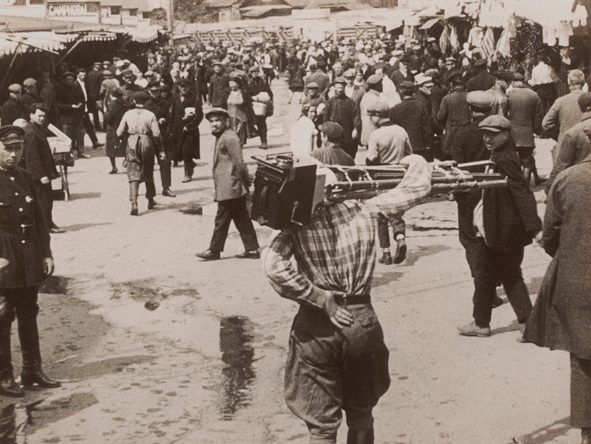
still Man with a Movie Camera (Chelovek s kinoapparatom) (Dziga Vertov, SU 1929)
Watch online
You can watch Eye's 2010 restoration (which reintroduces the original chaptered structure and includes sequences missing from other versions) of Man with a Movie Camera, including the score by Leo Geyer and Richard Bossons, on Eye Film Player.