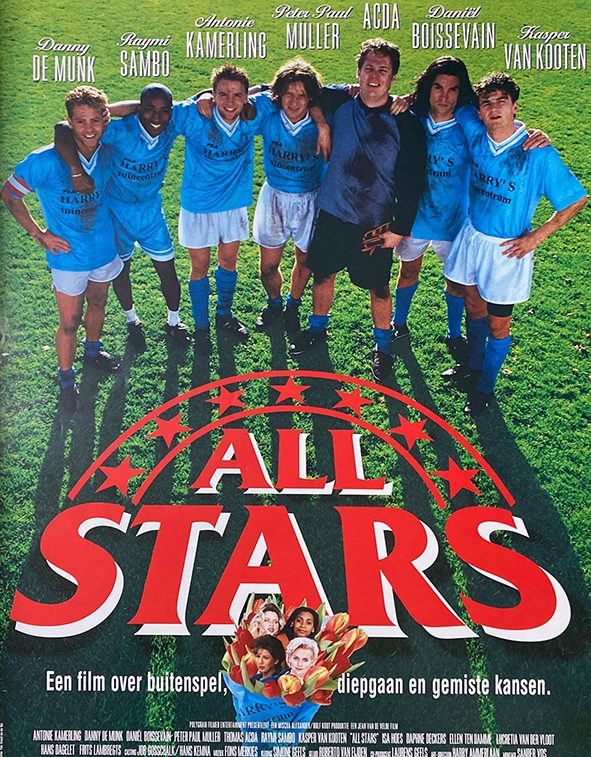
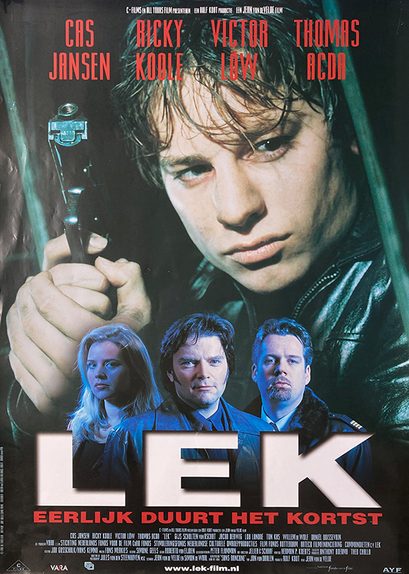
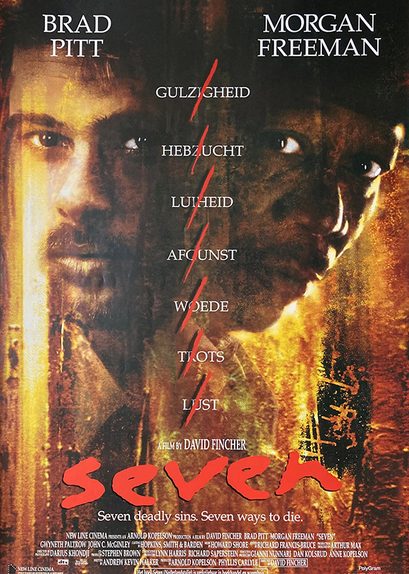
There was no need for him to flaunt his name; a strong network and proven quality meant he never had to solicit work or advertise. His work quietly found its way into the collective memory. For example, he designed the posters for both All Stars films and Lek, and also adapted posters for international films such as Dances with Wolves, In the Mood for Love and Se7en for the Dutch market. Of almost every poster, he kept a pristine copy in flat files. The contents of these were recently donated to Eye Filmmuseum.
Stopping power and emergency couriers: posters by Jaap Bollee
Almost without realising it, every (Dutch) film lover has at some point looked at the work of Jaap Bollee. With the donation of a collection of film posters he designed, he now steps out of anonymity.
By Michael Oudman22 December 2025
When designing or redesigning film posters, keeping the credits as small as possible was one of his trademarks. Add to this the fact that, if Bollee included his own name in the credits at all, he did so only under his almost untraceable company name Coma Prima, and it becomes clear why his name is unlikely to ring a bell straight away.
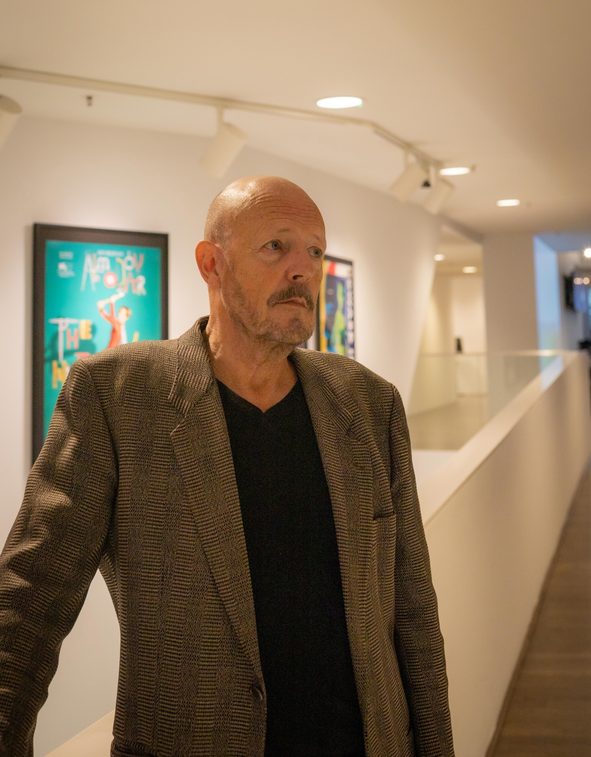
Foto © Michael Oudman
When Bollee began his career as a graphic designer in 1979, and went on to specialise in film posters in the 1980s, everything was still done in what we would now call the old-fashioned way. Although he was among the first in the Netherlands to start using an Apple Macintosh, film producers and distributors often supplied their visual material as hard copy.
Before he began delivering work digitally, Bollee worked with scissors and glue. “Once I’d finished a design, it would be sent by courier – there was a regular courier, an express courier and an emergency courier, who was often already waiting before I’d even finished – to the typesetter, the lithographer and the printer. When the printing process started, the head of the print shop would start up the press to get the colours right. The first posters went straight into the bin. Once everything was running smoothly, we’d take one off the press, put it on the lightbox and inspect it with a magnifying glass to see if everything was correct. A bit more blue here, a little more yellow there. Then the press would run again, and you’d compare the new version with the old one. Once everything was right, I’d sign it and the print manager would add his stamp. After that, the run would continue.” At that point, Bollee would take a copy off the press for his own collection.
What makes the collection now held by Eye so special is that the posters are in perfect condition. In the days of celluloid film, it was customary to send the poster to the cinema inside the film canister of the corresponding film – folded into quarters. And when the film moved on to the next theatre, the same poster would travel with it. Many old film posters bear the scars of that hard life, with fold lines and pinholes. Exposure to light often did the ink no favours either.
The posters Jaap donated, by contrast, went straight from the printing press into the drawers of his archive cabinet, where they were stored flat, undamaged and in complete darkness. They have since been transferred to the Eye Collection Centre. “I was invited there for a tour,” he says. “They have beautiful posters from the earliest French films, lithographs on wonderful paper – much thicker than what we use now. And so large too, about 2.5 by 1.6 metres. As a graphic designer, I have enormous respect for that history.”
Jaap continues: “When you make a poster, you naturally want to create the best poster ever made. A good poster has stopping power. If you’re cycling through the street, surrounded by neon, traffic lights, cars – all these impressions you have to process – you want a poster stuck to a pole somewhere to grab your attention. When that happens, it feels the same as when I’m playing with my band and we’re in the groove, exchanging glances in the hope of not losing it. Suddenly you’re floating fifteen centimetres above the ground.”
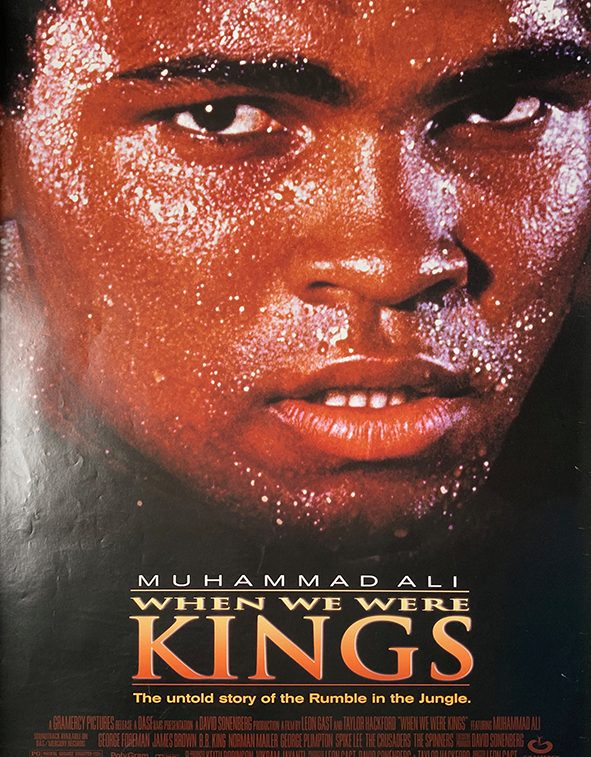
As an example of a poster with real stopping power, Bollee points to the poster for When We Were Kings. Such a sweat-soaked face, exhausted and beautifully lit, immediately grabs your attention.
One poster Jaap is less enthusiastic about is the original poster for Barb Wire. Although Pamela Anderson’s platinum-blonde hair catches the eye at first, she ultimately comes across as rather washed out. And then there’s the title, split over two lines and looking somewhat dull and lifeless.
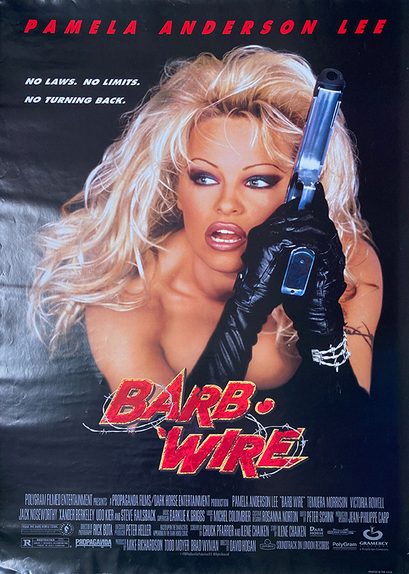
De oorspronkelijke versie (VS) van het affiche voor Barb Wire
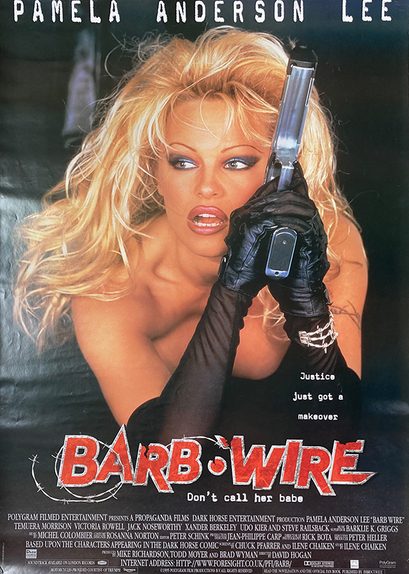
De VK-versie van het affiche voor Barb Wire
Bollee brightened Anderson up slightly and opted for a title with a sharp outline. “Mine is the best now,” he says with a mischievous smile. “I’ve improved it beyond repair.”
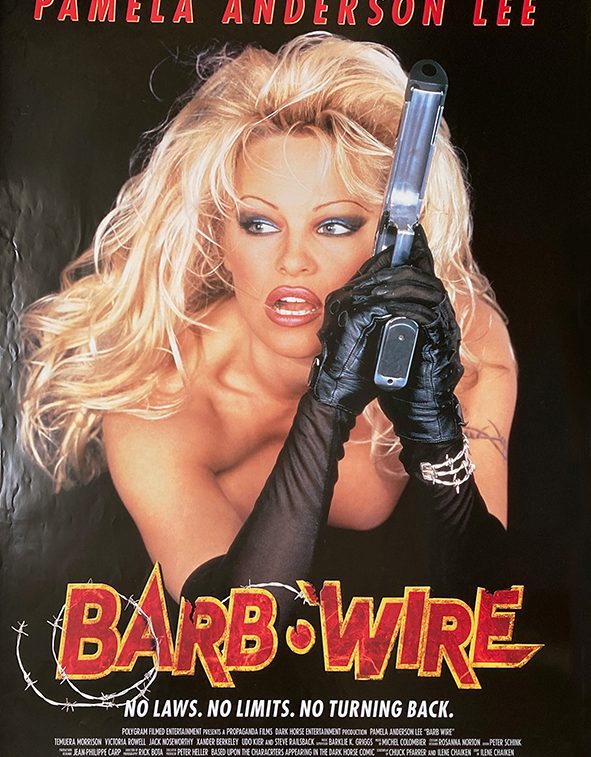
De Nederlandse versie van het affiche van Barb Wire, door Jaap Bollee
Bollee didn’t mind having to make the credits a bit smaller for that. “You have to be clever with it. For example, I chose a narrow typeface. I also varied the letter height: for the roles I used a font a few points smaller than for the names.” The extra space was often necessary because Dutch distributors also liked to have the soundtrack credited.
Jaap first stepped into the film world during the era of the Filmladder, which appeared every Thursday in all the newspapers alongside the film ads he designed for Meteor Film and The Movies, where Pieter Goedings was in charge at the time. “On Mondays they would discuss the film schedules and decide whether a movie would move from screen 1 to screen 2, or perhaps even to Vlissingen. On Tuesday morning I would be called into the office and given the new film titles, critics’ quotes, star ratings, and some basic artwork. By Wednesday afternoon, I had to deliver the ads to the newspapers. When Meteor Film started producing its own films, they needed a poster too. That’s when they said, ‘Why don’t you handle that?’ Because the film world is very small, eventually every distributor or producer knew how to find me.”
Work on the Filmladder page gradually decreased. They moved on to projects like covering trams with advertisements, which were updated with new designs every month.
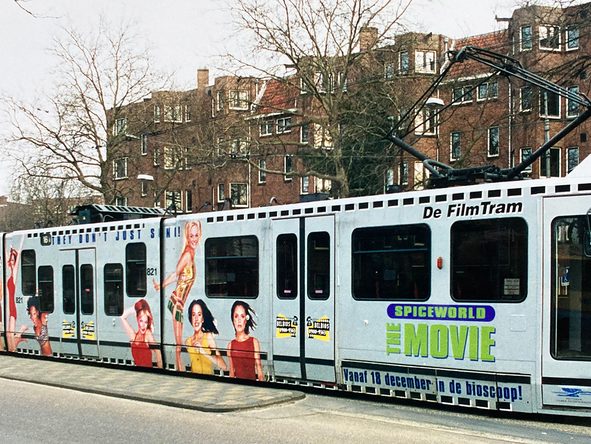
“I once did a tram for Spice World, the Spice Girls movie. That artwork was so beautiful, the girls were perfectly retouched.”
“The Austin Powers tram and the Mr. Bean tram also had 100% stopping power as they came around the corner. The trams were wrapped at the Havenstraat depot at two in the morning, after the last run. I often went to take a look. The GVB ran the trams on different routes, and in the morning I would call to ask which route it would take, so I could watch. Inside the depot, you don’t really see it properly – the wrap only truly comes to life in the street.”
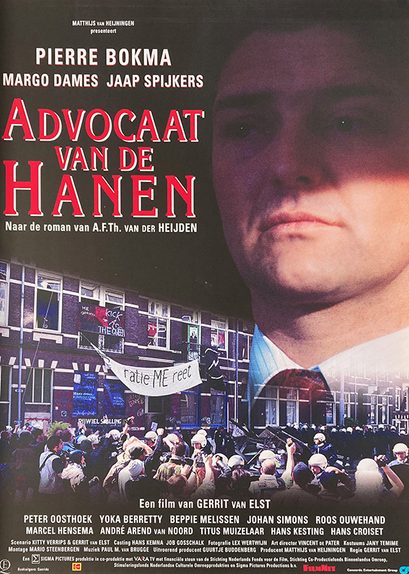
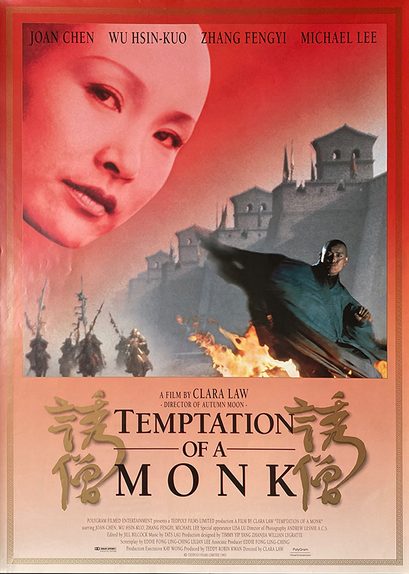
Although Bollee understands what makes a good film poster, he couldn’t always inject that stopping power into every design. “You have to work with the material you’re given and the budget available. For example, for Advocaat van de Hanen and Temptation of a Monk, I received very poor-quality images. I did the best I could with what I had. For Temptation of a Monk, I was allowed to use five colours for the first time: CMYK plus gold.”
“For Don Juan – a terrible film, by the way – I received an enormous handbook of requirements, drafted by the lawyers of Johnny Depp, Marlon Brando, and Faye Dunaway. It included instructions like: if Faye is placed on the right, she must be looking that way, and she must be at least this size.”
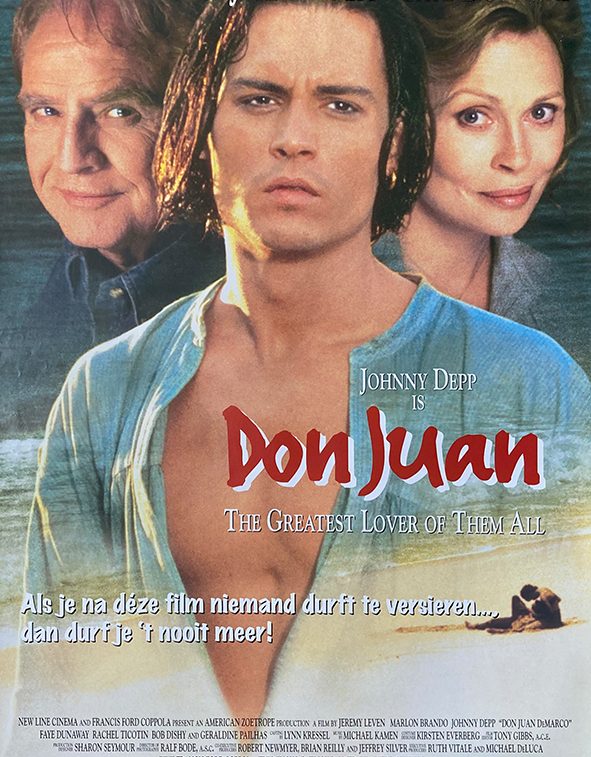
The names and the headings of the actors on the poster then become even more important than the film’s title. Yet there is no single winning formula for the best typographic solution. “It’s all about readability. The Netherlands has a strong graphic design tradition; at the beginning of the last century, we designed many typefaces that are still in use today. The shape of a letter is determined by the space around it. For body text, I always use serif fonts, as they visually connect the words.”
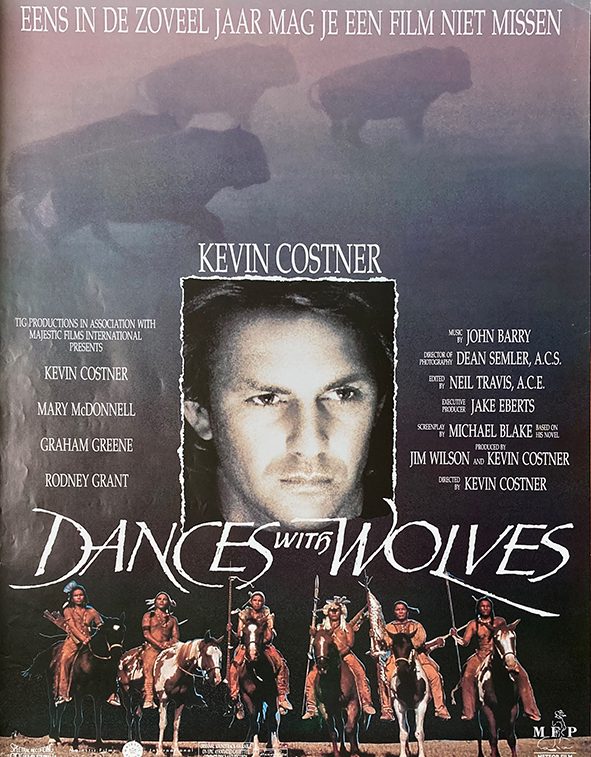
Now that we’re talking about text, Bollee suddenly remembers a saying from former distributor and film producer Haig Balian: “When Dances with Wolves came out, he said, ‘Once in a while, there’s a film you simply must not miss.’ After that, all the distributors copied it – until it stopped working. And Rob Houwer always meddled with the poster copy as well. If someone said his text wasn’t proper Dutch, he would just say he did it on purpose.”
A number of the films for which Bollee designed posters have since been re-released in restored form. For these reissues, Bollee’s posters sometimes had to make way for new artwork. “I can let that slide fairly easily.” Less easy to accept are the puns. “I’m not happy with the title of the film Affair Play. You see that quite often: someone invents a little pun. The next day, you’re thinking, ‘Perhaps we shouldn’t have done that.’”
The artwork Bollee created for All Stars was based on the script, before a single frame had been shot. “I read the script and thought of sagging socks and mud. For the title, I slightly misused the Champions League logo. Jules van den Steenhoven (DoP) climbed a ladder between scenes to photograph the lads. Then the distributor suddenly wanted the players’ girlfriends included too, suggesting we put them in a little bunch of tulips, which was a bit less successful.”