
Painting Blue
‘Blue is the universal love in which man bathes – it is the terrestrial paradise. […]
In the roaring waters
I hear the voices of dead friends
Love is life that lasts forever.’
– Derek Jarman in Blue (1993)
When entering the exhibition Tilda Swinton – Ongoing, the first works you encounter are those by Derek Jarman. A filmmaker, writer, painter, gardener, and political activist, Jarman was a close friend and collaborator of Swinton. The two met when she auditioned for the role of Lena in Caravaggio, her first role in a feature film. They formed a creative bond that lasted until Jarman’s death in 1994. Their collaboration shaped both their careers and led to several feature films. Films like The Garden, Edward II, Wittgenstein and more, will be shown during a special screening programme as part of the exhibition in Eye.
By Diede Al10 October 2025
‘Blue is the universal love in which man bathes – it is the terrestrial paradise. […]
In the roaring waters
I hear the voices of dead friends
Love is life that lasts forever.’
– Derek Jarman in Blue (1993)
A wide-eyed boy gazes out from the canvas with an inquisitive look. His slouched shoulders hint at a quiet shyness, a sort of reluctance to be seen, as he sits before an abstract backdrop of blue colour fields. The boy in the canvas is 16-year-old Derek Jarman, who painted this self-portrait in 1959, just a year before he started his studies in English and Art, marking the start of a career that would establish him as one of Britain’s most influential voices in filmmaking, writing, and political activism.
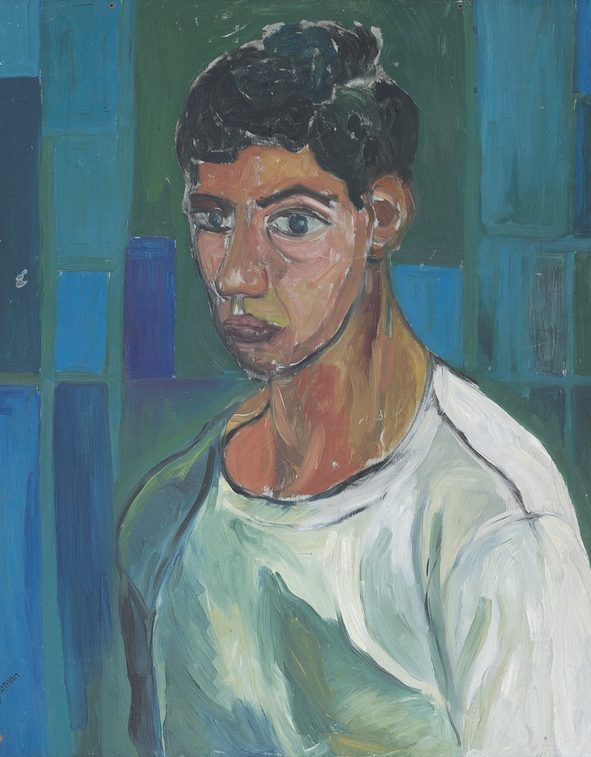
Derek Jarman, self-portrait (1959)
Retrospectively, the self-portrait has an almost eerie effect. The enveloping blue background seems to be in dialogue with Jarman’s last film Blue. It is as if the self-portrait of the boy with the piercing eyes had glimpsed at what was to come. The two works draw a timeline of the artist’s life, from the young Jarman who studied to become a painter to the autobiographical film which Jarman made in the last years of his life. The 1993 film features Jarman’s poetic meditations on living with AIDS and his gradual failing eyesight heard over only a monochrome background of Yves Klein Blue. Blue would become one of his most celebrated works, some even regarding it as his greatest, in a wide-ranging oeuvre that spans film, painting, literature and even his garden at Prospect Cottage in Dungeness.
It is the colour blue that, for Jarman, evokes a sense of elusive universality, a tangible affect that, as Jarman describes it in Blue, ‘transcends the solemn geography of human limits.’ For Jarman, blue is more than just a colour, it becomes a language of love, loss, and mourning. It gestures toward something bigger than life, yet also serves as a lens through which life itself can be understood, felt, and given meaning. His meditations on the colour blue not only reflect the painterly sensibilities he brought to his work, but also provide a key to understanding his body of work and the enduring influence it continues to have today.

still Blue (Derek Jarman, GB 1993)
In this article I will explore several of Jarman’s works through that lens to understand the emotional, artistic and political impact of his films. It is in his work that we can read hope in nihilism, power in alienation and a call to carry his political activism into the future. By watching his films and reading his works we not only honour the artist, but also look towards a future like the 16-year-old Jarman did in his self-portrait, tracing the marks that his work left on time itself
As Tilda Swinton writes in her letter to Jarman on her sudden, violent feeling of grief in the Ongoing catalogue: ‘Ghosts (and film) can do this to us – bludgeon us with the fact of time when we least expect it, just when we’ve convinced ourselves it doesn’t actually leave a mark.’
‘Whenever you walk in a sunny bluebell wood, remember it is the heart of passionate love.’
– Derek Jarman in Pharmacopoeia (2022)
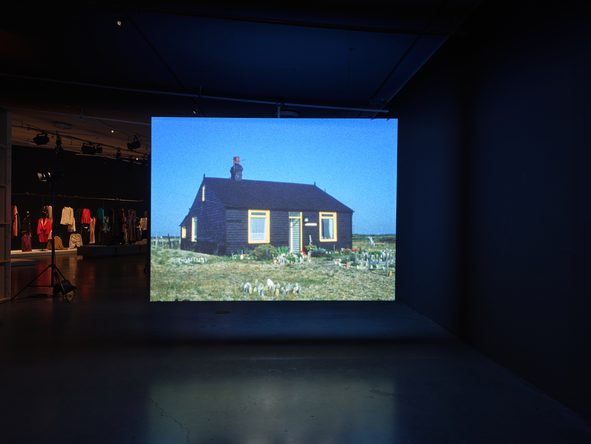
Timeslip (Derek Jarman, 1988/2025) (© Studio Hans Wilschut)
In 1986 Jarman bought a cabin in Dungeness (Kent) where he lived and worked for the last years of his life. Jarman called the tar-black wooden cabin, situated next to a nuclear reactor, Prospect Cottage. In the shingles surrounding the cottage Jarman created a garden that, due to a successful campaign spearheaded by Tilda Swinton, is still preserved to this day. In Dungeness, in a landscape where the wind blows sharp and nothing seemed to be growing, the garden became a gesture of beauty and hope in an otherwise hostile environment.
Pansies, Celandine, violets and sempervivums now grow in between the shingles and stone sculptures of the garden. Prospect Cottage was a refuge for Jarman, who had been diagnosed with HIV just before he bought the house, but also a playground in which he could experiment and expand his artist practice.
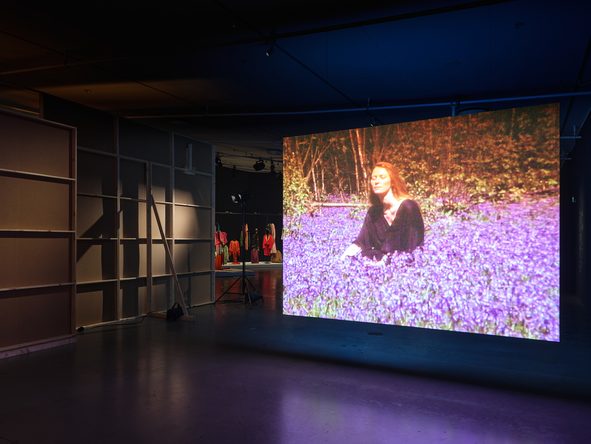
Timeslip (Derek Jarman, 1988/2025) (© Studio Hans Wilschut)
In Tilda Swinton – Ongoing, previously unseen footage reveals Swinton roaming through the bluebell wood near Prospect Cottage. This intimate footage, shot by Jarman on super 8 film, reveals the collaborative bond between Swinton and Jarman. In the audio tour of the exhibition, Swinton explains that these shoots were a way of building up her confidence, it was for her to practice ‘being unseen’, but it also shows how Jarman and Swinton could blend their creative process with their cinematic work.
During these shoots Jarman would film moments that later became part of his films The Last of England (1987) and The Garden (1990), showing the deeply personal nature of the films.
The Last of England was the first of the two films to premiere. The film is a critique on Thatcher’s England, especially protesting Section 28, a law that prohibited “intentionally promot[ing] homosexuality or publish[ing] material with the intention of promoting homosexuality.” This meant that, with banning the ‘promotion’ of homosexuality in schools and public spaces, people from the queer community were essentially silenced, a tactic that has since been used by other right-wing governments. With its rapidly edited footage, flickering like the flames of the fire in front of which Swinton cuts, tears and bites away her wedding gown in The Last of England, the films defy conventional narrative and present an audio-visual work of political activism.
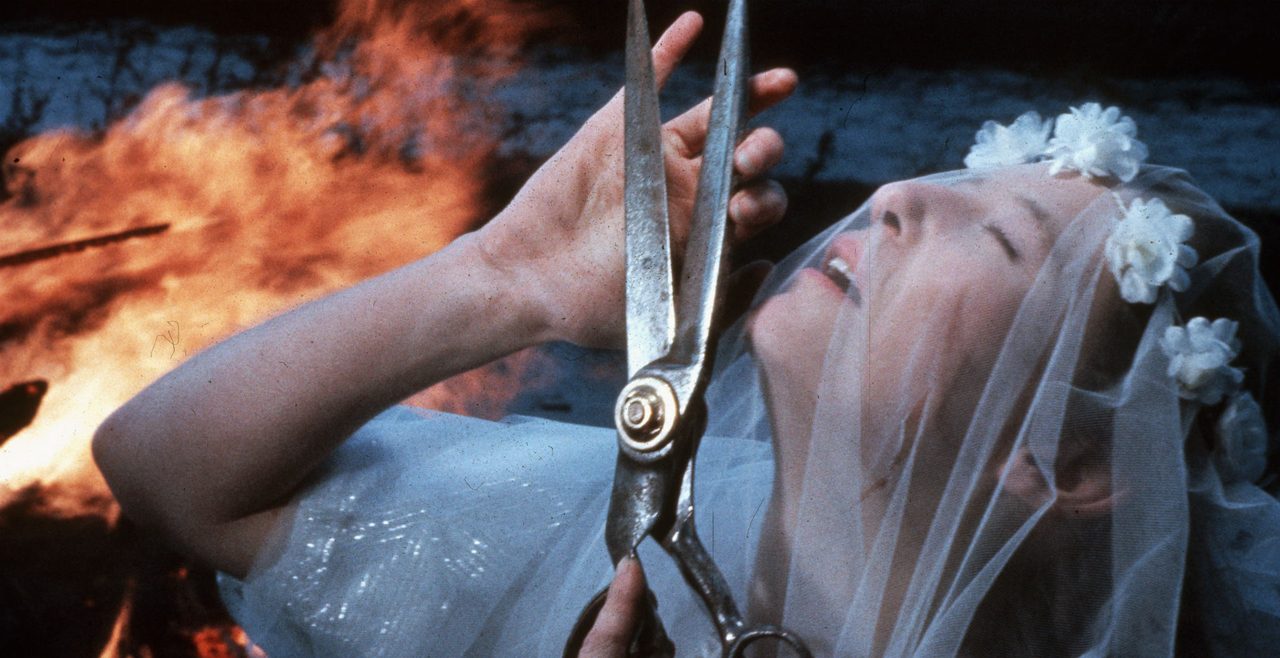
still The Last of England (Derek Jarman, GB/DE 1988)
In an era when those with HIV were openly antagonised, Jarman was one of the few public figures to come forward with his diagnosis, a defiant political act in a deeply hostile climate. This would also inform his art practice, which became another powerful and radical form of political engagement. For example, the dead squats seen targeting a homosexual man in The Last of England is a powerful statement not only on Thatcher’s privatisation of nationalised industries, but also on a willfully indifferent government deciding whose lifes are worth living and whose are not. This theme continues in The Garden, in which we see gay men getting murdered in a ritualistic manner, their bodies lie in a quiet embrace on Dungeness’ bare shingle beach overlooking the sea.
Although the films can be (and are) described as nihilistic, they hold a form of queer hope: the belief that something new might emerge from what has been lost or destroyed. It is like the myth of Hyacinth, which Jarman references in his posthumously published book Pharmacopoeia. In the myth, the love between the Greek prince Hyacinth and the god Apollo is tragically cut short when a jealous Zephyrus kills Hyacinth while the young prince is playing quoits on the beach with Apollo. Stricken with grief, Apollo grows a flower from the drops of Hyacinths blood. This flower, a bluebell hyacinth, becomes the symbol of the beauty in grief and loss. The essence of this myth, that something new and beautiful can appear from loss and destruction, like the bluebell hyacinth, is echoed in his work. In The Last of England we see Swinton in the bluebell wood, the place of ‘passionate love’ in which we can find refuge from the barren surroundings.
In her performance in The Garden Swinton also conveys this sense of hope in a desolate landscape. In the film she is painted as an almost holy figure – religious iconography plays a big part in Jarman’s work, more on that later – portraying hope in a sometimes disturbing collage of violence. The garden of Prospect Cottage blooms, it is watered by Jarman, the blue of the sky frames him as he lies asleep in a bed surrounded by the deep blue of the sea’s water. ‘I have walked behind the sky,’ he writes in Blue, ‘For what are you seeking? The fathomless blue of bliss.’
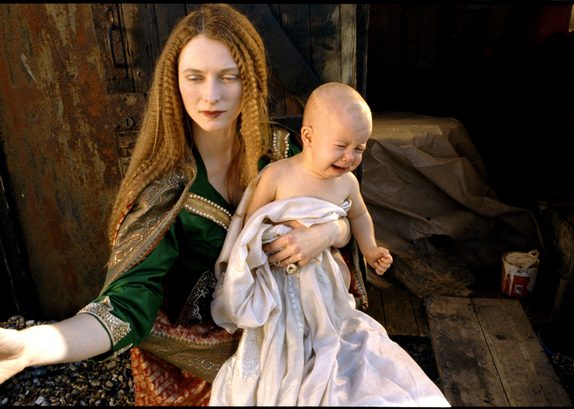
still The Garden (Derek Jarman, GB 1990) (foto: Liam Daniel © Basilisk Communications Ltd)
In 2020 Swinton started an artist-in-residence programme at Prospect Cottage, carrying his work to future generations. Now the house, with its yellow window frames echoing the color of the helichrysum angustifolium flower in the surrounding garden, has become a space for new generations of artists to experiment like Swinton and Jarman did.
‘Blue blood is ruby.
Blue lies.’
– Derek Jarman in Chroma (1994)
On 22 September 1991, Jarman was canonised by the Sisters of Perpetual Indulgence, a group of American queer performers and political activists. The ceremony took place on the shingle beach near Prospect Cottage, where the Sisters declared Jarman ‘Saint Derek of the Celluloid Knights of Dungeness’.
The Sisters of Perpetual Indulgence emerged in the late 70’s from the gay liberation movement in San Francisco. Their activism was provocative, using religious iconography and rituals to draw attention to political issues, such as the AIDS crisis and the systematic discrimination and stigmatisation it was rooted in. Their satirical approach was controversial but, as one member put it: ‘We were really, really, really sick of being nice to people.’
However, as cultural and arts historian Dominic Janes noted, rituals such as the canonisation of Jarman were not only a form of provocation but also a form of reappropriation. It reclaimed religious symbols and traditions that mirrored queer forms of being, such as the position of both the queer and Christian subject being rooted in shame and suffering. With the use of religious iconography Jarman did not shy away from this analogy in his films. The filmmaker, himself an atheist, took Christianity and the issues it posed on queer life very serious. He, for example, dedicated his film War Requiem to ‘all those cast out, like myself from Christendom. To my friends who are dying in a moral climate created by a church with no compassion.’
During the canonisation Jarman wore the gold cape worn by King Edward II in his film adaptation of the 1593 play by Christopher Marlowe. This gesture shows the constant interplay between his personal life, political activism, and his work as a filmmaker. In his films you will find personal reflections on (queer) identity and power. Not only his abstract films, but also the films with a more traditional narrative such as Caravaggio, War Requiem and Edward II.
A pregnant Lena, portrayed by Swinton, posing as Magdalene for Michelangelo in Caravaggio. The golden light brushes the right side of her face as she looks away from the painter’s gaze. Beside her chair, on the ground, stands a vase. It is a symbol of sin and salvation with which Magdalene was often portrayed in medieval art. In the scene the vase is outlined in chalk, as if found on a crime scene. The crime Lena is accused of, like Magdalene in religious discourse, is simply the act of taking agency as a woman. ‘Whose baby is it?’ asks Ranuccio, to which Lena replies: ‘Mine!’
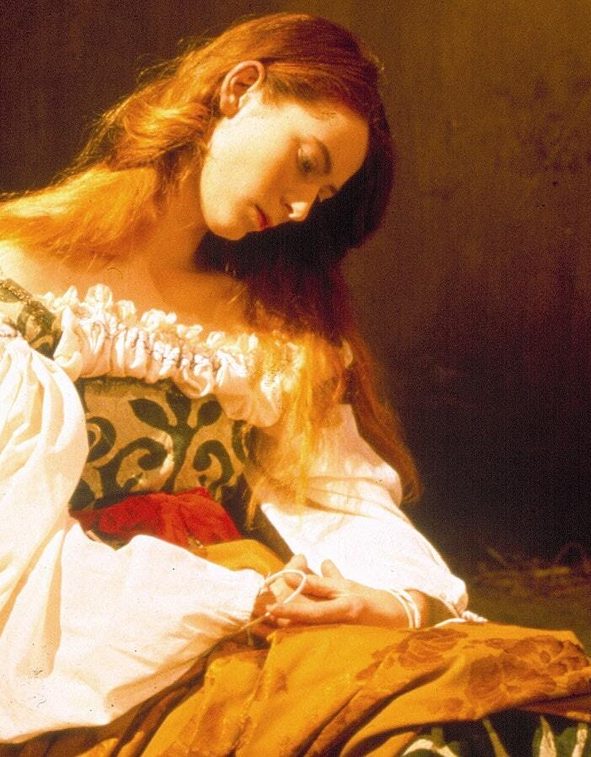
still Caravaggio (Derek Jarman, GB 1986)
With Lena, Jarman and Swinton used religious iconography to create a character with an inherent queer disposition. Being one of the few female characters in this beautifully shot film, the character of Lena becomes alienated when the promise of power draws her love interest Ranuccio away from her towards Caravaggio. Rather than being portrayed as a yearning woman, Lena chooses to become powerful herself by choosing to align herself with royalty, with blue blood. Later, the character will find that in either sin or salvation she will be found guilty. The portrayal of Lena by Swinton reflects on feminist and queer resistance that transcends time. Watching the rereleased film today, the theme of oppression through power in Caravaggio remains relevant.
Caravaggio started the creative collaboration between Swinton and Jarman, which would develop further in later feature films, such as Wittgenstein and Edward II. Their close personal and professional relationship shaped characters that feel honest and defiant, breaking the boundaries of how women were portrayed in film. From the use of religious iconography a radical queer sensibility is developed. A sensibility that Swinton still holds today. ‘I always felt I was queer,’ she once told British Vogue, ‘I’m very clear that queer is actually, for me anyway, to do with sensibility.’ And with this queer sensibility Swinton still carries the legacy of Saint Derek of the Celluloid Knights of Dungeness.
In the audio tour of the exhibition you hear Tilda Swinton speak about her friend. It is touching, the way she recalls their friendship and their artistic collaboration. With her first role as Lena in Caravaggio Swinton started her career that would form the foundation to the performer we know today. Her relationship with Jarman seems to be what shaped her way of collaborating with the artists featured in the exhibition. It is an ongoing process in which she still carries the legacy of Jarman.
That legacy, as a filmmaker, painter, writer, and political activist lives on as a tangible affect in people like Swinton, who carries his legacy into the future. His art is a testament to art as a form of resistance with an intimacy that can transcend time. To watch his films, read his books and see his paintings is not only to honour his contributions to his present, but also to trace the future he imagined.
As Swinton writes in the exhibition catalogue:
‘You always told us that you yourself were the beneficiary of your forerunners, your mentors, and idols. That they were your company and that we were, too. So, we go forward, onward and with our spirits evolving. Towards new plantings, enlivening light, fresh snow.’