
That invisibility is the subject of my research at Eye. I set out in search of traces that queer initiatives in the Netherlands have left behind in the film museum's collection, paying particular attention to work by women and and non cis-males of FLINTA (Female, Lesbian, Intersex, Non-binary, Trans, Agender). When I first started asking at Eye about lesbian films, I kept getting the same answer: "There's hardly anything." I wasn't about to accept that. I knew the material was there. The only question was: where to begin?
But before I dive in, let me show you what I wish had been served to me on a silver platter: a neat little compilation of films, both short and feature-length, professional and student work, all celebrating the beauty of relationships between women: strength, support, warmth, happiness. Think of this as a mise en bouche, a taste of what's already been uncovered and a teaser for what still lies hidden.
Between the lines: in search of lesbian stories in Dutch film history
Lou Burkart, curator at Eye Filmmuseum, gave the talk The Dutch Celluloid Closet, part of the film programme Queer Power, on the visibility of lesbians and the art of queer coding in Dutch film: subtle signals, a look, a gesture, a storyline, recognised by the intended audience but going unnoticed by everyone else. This is an edited and abridged version of their journey through the archive.
By Lou Burkart17 July 2026
The starting point of my story is the campaign for the second, and final, edition of the Amsterdam Gay and Lesbian Film Festival, from 1991. The poster featured two fictional same-sex couples locked in an embrace: Paul Newman with Marlon Brando, and Marilyn Monroe with Brigitte Bardot. A subversive move that laid bare, in a single image, just how invisible homosexual relationships really were on the silver screen.
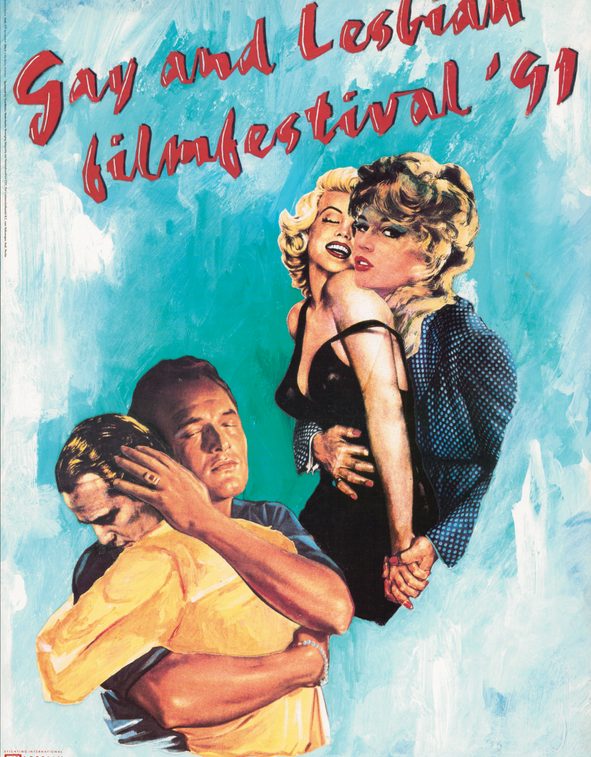
Affiche Gay and Lesbian filmfestival '91
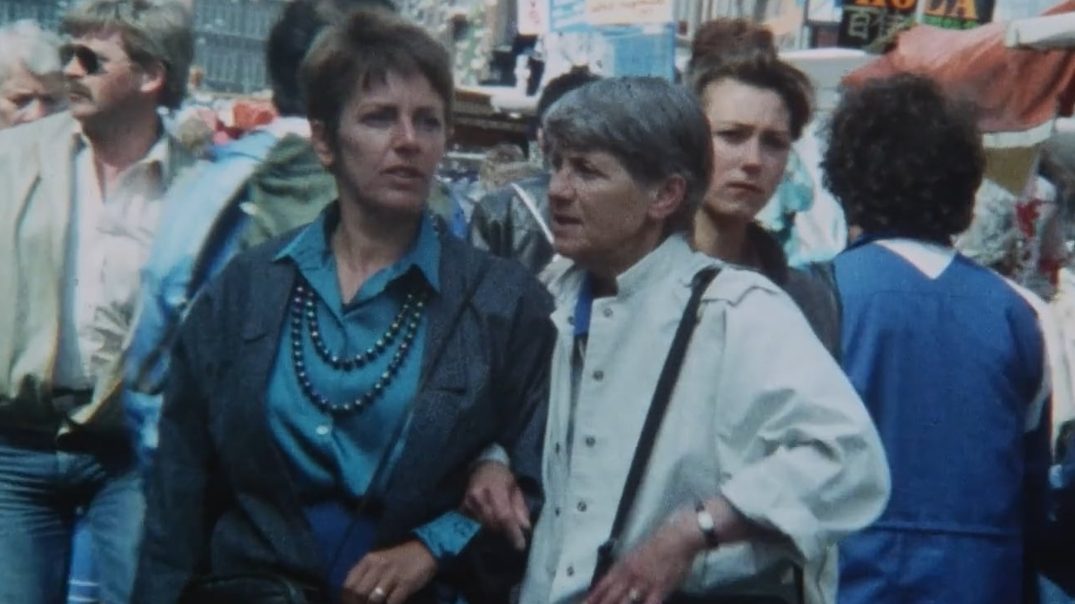
Did you notice their bonds, their dreams, their relationships, the interplay of bodies, the use of space and editing, the exchanges of gazes?
The search
I wanted to explore the traces these films have left behind in our film archive. My focus, naturally, is on Dutch productions. But as a curator, I also wanted to cast a wider net: to examine how, over the past century, women and non cis-males of FLINTA have carved out space to tell their own stories. So I went digging for lesbian narratives, coded or overt, subtle or unmistakable, hidden in our collection.
But where do you begin when none of these films had keywords linking them to the queer stories they so clearly told? Searching the film descriptions proved useless: if a description existed at all, the chance it included relevant keywords was slim to none. Slightly more fruitful was tracing the festivals where these films had screened. Festivals whose names included the words "gay", "lesbian" or "queer" yielded thirty-one films in our catalogue. Filter out the men, and you're left with fewer than fifteen. And we know that's still just the tip of the iceberg.
The next step led me through archives like IHLIA LGBTI Heritage and the Internationaal Instituut voor Sociale Geschiedenis (IISG), which hold feminist and socio-political collections. One clue led to another: organisations like COC, distributor Cinemien, specific cinemas, festivals, and independent distributors. On one side, I found queer-related material that barely included Dutch productions, let alone ones by women filmmakers. On the other, documentation from feminist groups in which references to homosexuality were almost entirely absent. The former is straightforward: country of production and a name are easy to search. The latter, however, demands reading between the lines.
A trail of festivals
Gluren in 't donker (Glooming in the Dark), one of the earliest queer film festivals I came across, originated in Nijmegen, emerging from political, feminist and gay groups around the local university. Individual screenings grew into a festival in 1978, in partnership with a local cinema and Amsterdam-based political allies: first in Nijmegen, a month later in Amsterdam. Its success inspired a Belgian counterpart, the Janettenfestival. Dutch productions were included, but none directed by a woman.
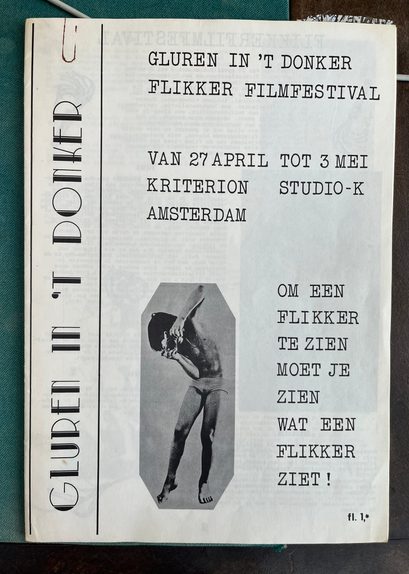
Programmaboekje van Gluren in 't donker, een van de eerste queer filmfestivals in Nederland (bron: IHLIA)
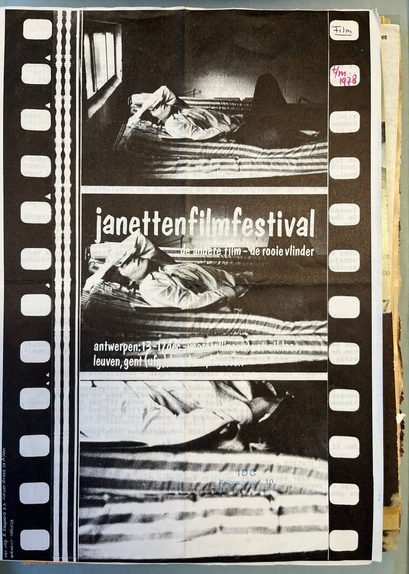
Aanplakbiljet van het Janettenfilmfestival in België (bron: Atria)
It was at a broader festival that I unearthed the first screening of a Dutch lesbian production: Pottenkijken (loosely translated as ‘Checking Lesbians Out’). The screening took place on 'Women's Viewing Day', 28 September 1980, as part of a special programme titled 'Women and Lesbian Relationships'. The festival was Festikon, a fiercely political event in the 1970s and, in fact, the precursor to today's IDFA.
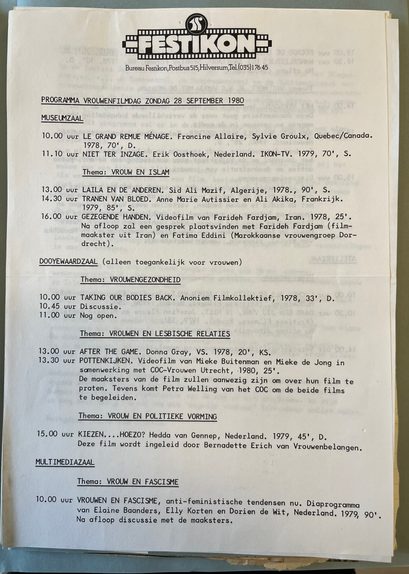
Het programma van de vrouwenfilmdag tijdens Festikon
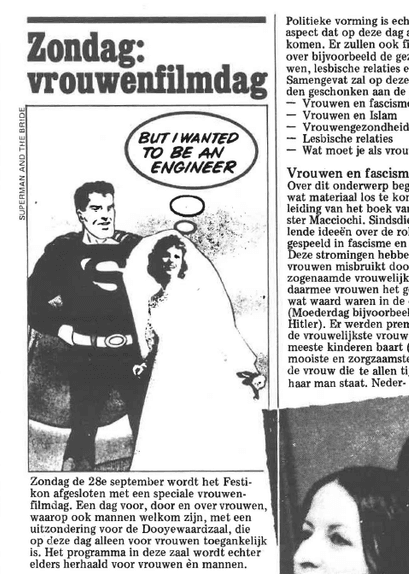
Een artikel over de vrouwenfilmdag tijdens Festikon
COC, which supported Pottenkijken (Mieke Buitenman, Mieke de Jong, 1980), is one of the oldest LGBTQIA+ organisations in the Netherlands. It was founded in 1946 as Cultuur en Ontspanningscentrum (Centre for Culture and Leisure), a cover under which queer gatherings could be organised. The name has remained, its influence has only grown.
The Vrouwen Film Festival Assen, which began in 1980, boasts by far the strongest continuity of all the initiatives I found. Its focus was not on LGBTQIA+ films but on films by and about women, driven by pedagogical and social goals: many of its titles that entered Cinemien's catalogue, were intended to spark group discussions afterwards. In its early years, the programme featured only films by women directors. Precisely because the emphasis lay so heavily on women, the film descriptions rarely highlight the underlying queer narratives. But given its consistent showcase of Dutch productions, this is a treasure trove I'm still sifting through.
I then came across Yet Each Man Does Not Die, a 1985 film festival on "film and homosexuality", curated by Paul Verstraeten, who later became co-programmer of the Gay & Lesbian Film Festival. The programme included two Dutch productions from 1965, but as the title suggests: lesbian narratives were absent.
A year later, in 1986, the first edition of the Gay and Lesbian Film Festival took place, organised together with COC, distributor Cinemien and cinema Desmet. The festival had only two editions, in 1986 and, five years later, in 1991, the edition with which I opened this journey. Yet its impact endured. One of its defining features was its commitment to an equal split between films by women and men, in a programme that combined historical retrospectives with international queer cinema, from silent films to productions from India. Alongside the screenings, the festival also organised a symposium on producing and screening more queer films, a DIY workshop on (porn) video production for lesbians, and a competition to encourage the writing of queer film scripts.
The trailer for the 1991 edition deserves special mention. It's a vibrant montage of empowering queer relationships. And, as the records note, it was hailed at the time as the first homoerotic production in the Netherlands.
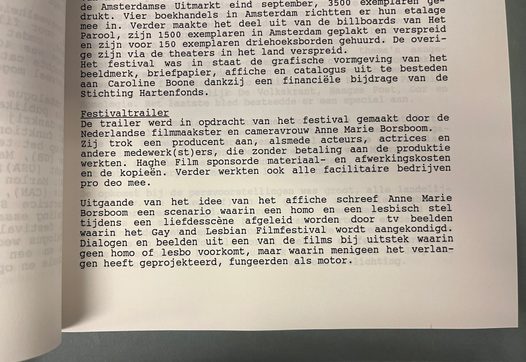
Omschrijving van de trailer voor het Gay and Lesbian filmfestival 1991, uit het verslag (bron: Atria)
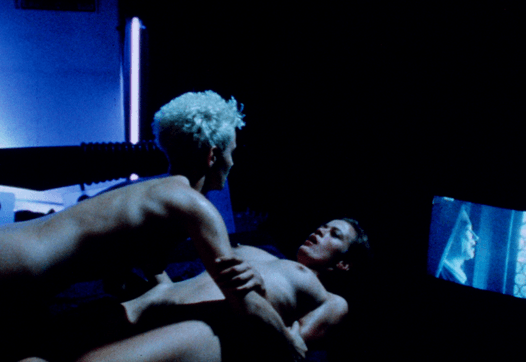
Still uit de trailer voor het Gay and Lesbian Filmfestival '91
The events that followed were less relevant for my focus: In and Out the Closet (June 1994) featured only English-language productions from the United States, the United Kingdom and Canada.
The final stop in this chronology is De Roze Filmdagen, whose first edition took place in 1996, inspired by the Gay and Lesbian Film Festival and with the explicit ambition of creating continuity. Successfully so, as the festival still exists to this day. The 1997 line-up was telling: a solid selection of Dutch productions by women, supplemented with titles from previous years, a rarity among these events, especially for Dutch cinema.
Outside of the festivals
Not every trail runs through a festival. In 1975, I found lesbian narratives in the catalogue of the National Centre for Mental Health, offering a glimpse into the nuanced language of that era. By 1983, terms like 'homosexuality' and 'lesbian lives' had cautiously begun to appear in the catalogue of the Association of Sexuology. But there too, one had to read through layers of institutional judgement: screenings were carefully framed within a context of sexuality and its societal implications, even in a supposedly tolerant society.
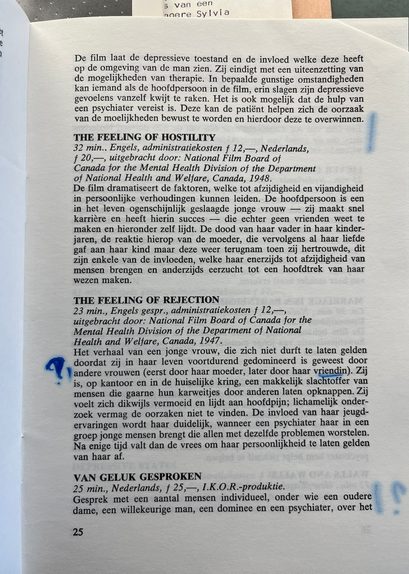
Een pagina uit de 'Katalogus van Films' uit 1975 van het Nationaal Centrum voor Geestelijke Volksgezondheid, afdeling film (bron: IISG)
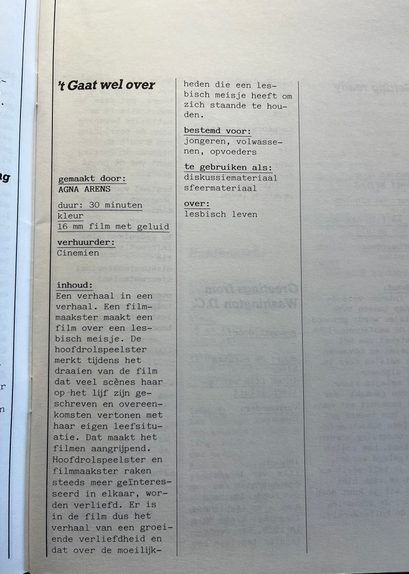
Een pagina uit de Catalogus van de audiovisuele visiedagen in 1983 van de Vereniging voor Sexuologie (bron: IISG)
Between the lines: the example of Mara
When screenings weren't explicitly organised for a gay or lesbian audience, film descriptions often erased or downplayed queer narratives, even in places where you might expect the opposite. Both the Vrouwen Film Festival Assen and distributor Cinemien danced around the words lesbian or gay, likely fearing they might alienate a broader audience who already assumed such films weren't meant for them.
I'll illustrate this with the film Mara (Angela Linders, 1985). The description in the distribution leaflet is reserved:
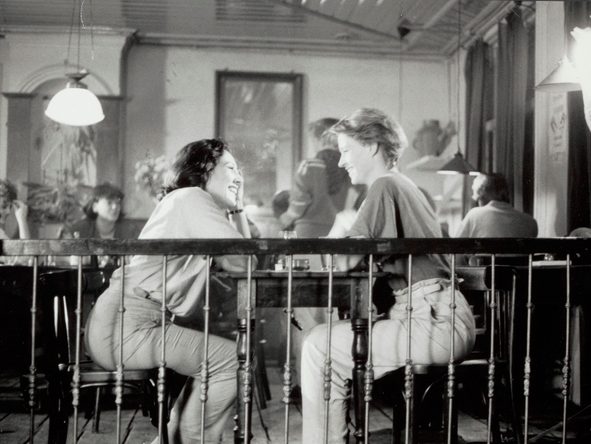
still Mara (Angela Linders, NL 1985)
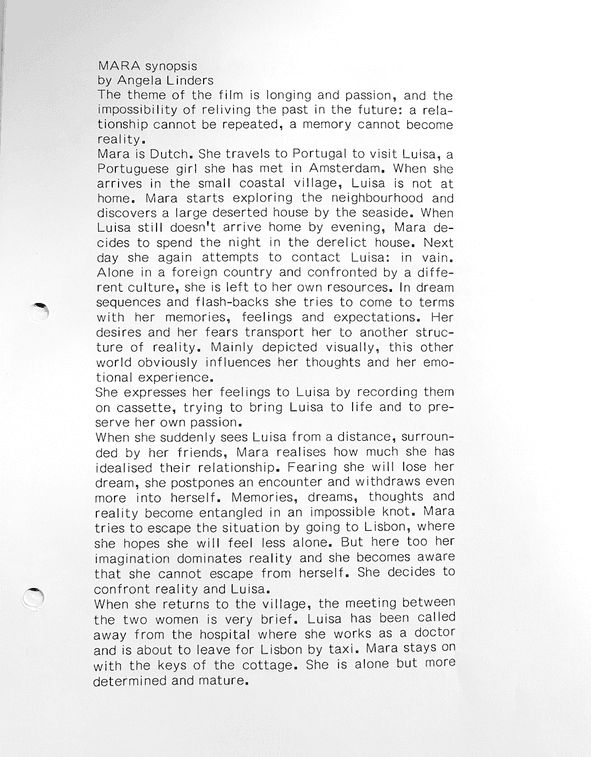
"Mara is Dutch. She goes to visit her Portuguese friend Luisa but fails to meet her. Alone in a foreign country, she spends a few days in a deserted house by the seaside. Visual narration is mainly used to reveal the way that Mara's feelings, thoughts and emotions affect her own special reality. In dream sequences and flash-backs she tries to arrange her memories and expectations. In the end she is able to face her friend with more firmness and maturity."
A longer description in Eye's own archive (pictured here) is far more explicit about the relationship between the two women.
It's only in the film descriptions of gay and lesbian festivals themselves that queer representation truly steps into the light: the storylines are laid bare, the relationships between characters made clear, and the intended audience directly addressed, as with Koekoekskinderen (Eugenie Jansen, 1991), in the catalogue of the 1991 Gay and Lesbian Film Festival:
"Two girls who are clearly in love hear some passionate love poetry during their Dutch lesson. Their teacher plays down the passion and calls such feelings exaggerated. But the girls’ curiosity has been piqued and they set out to find the poet to uncover his secret. No poetry without love, no love without poetry – that could be the motto of Koekoekskinderen."
And on Een vrouw als Eva (Nouchka van Brakel, 1979), in the 1997 De Roze Filmdagen programme booklet:
"The life of a bored Dutch housewife is turned around when she rejects her bourgeois marriage, discovers feminism and then becomes romantically involved with anther woman. This sensitive drama stars Monique van de Ven as Eve who finds fulfillment in the arms of Liliane, a free-spritited lesbian folk singer (Maria Schneider). An early European effort at depicting a positive portrayal of lesbians which was made by a production crew of primarily women."
Learning to read the codes
To bring order to this material, I worked with a simple framework, built around two variables – the production and the storyline – and brought them in relation to the closet: out or in?
If both the production and the storyline are out of the closet, the film is openly queer.
Other films have characters living in the closet, but the production can nonetheless be read as queer (out).
Or: both the production and the storyline remain in the closet. The characters are read as straight, in a production that appears straight. Until you know what to look for.
It's precisely this third category where reading against the grain (interpreting a work against its obvious or intended meaning, by paying attention to what remains unspoken or lies beneath the surface) becomes indispensable. Not because the makers hid something from those willing to see it, but because society simply didn't allow it to be spoken aloud. What remains is a coded language of signals.
Some signals are accessible to anyone willing to look closely. Think of it almost as a game, a puzzle to embrace. Other signals demand a deeper understanding of queer history: an internationally recognised symbol, a notable figure, a piece of local lore. The following two examples are firmly rooted in Amsterdam.
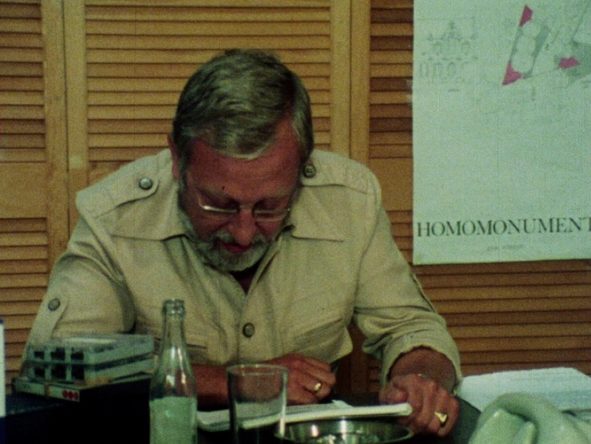
still De geest van gras (Marleen Gorris, Mieke van Kasbergen, 1982)
Take, for example, the poster in the background of De geest van gras (Marleen Gorris, Mieke van Kasbergen, 1982), which references to the design of the Homomonument.
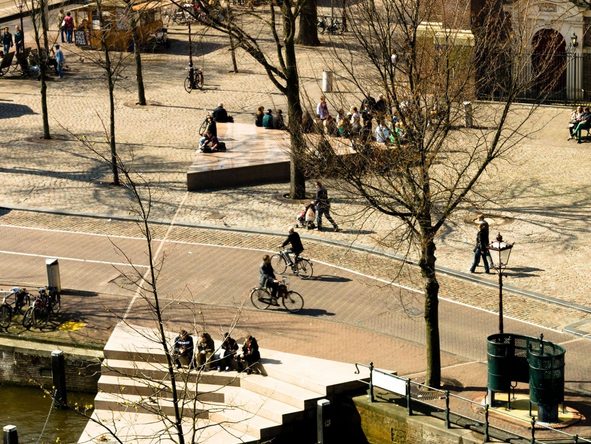
Het Homomonument, naast de Westerkerk in Amsterdam
The Homomonument, unveiled on 5 September 1987, was at the time the world's first monument dedicated to homosexual men and women murdered by the Nazi regime.
Designer Karin Daan gave it the shape of one large pink triangle made up of three smaller triangles, the very symbol the Nazis used to brand men accused of homosexual acts. One of the triangle's three points faces the former office of COC Amsterdam, a nod to that organisation's pivotal role in the Dutch LGBT movement. Another points towards the Anne Frank House.
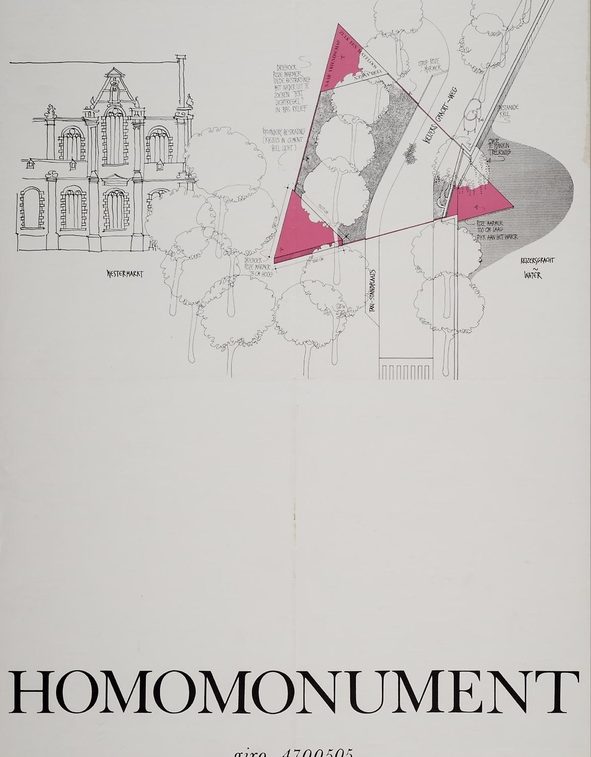
De poster van het Homomonument die ook te zien is in De geest van gras, met het ontwerp van Karin Daan (bron: Atria)
After this example of local history, let's turn to meeting points for queer people, often underground. These were clearly defined spaces for specific communities. Inviting someone to one of these places required fluency in codes: a green carnation, inspired by Oscar Wilde, or violet, this time a nod to Sappho, the Greek poet.
In the 1980s, when a female character referenced a women's café, it could mean a feminist meeting spot, a lesbian bar, or sometimes both.
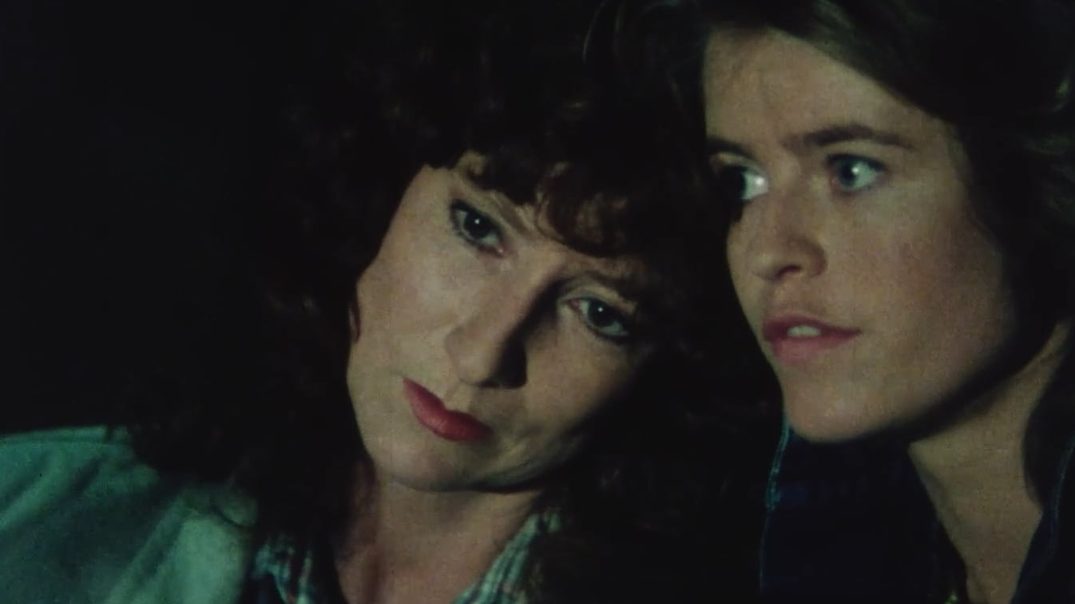
Now, given the local history, and knowing this film was shot in Amsterdam: what might it mean when one character takes another to a women's café in Amsterdam? For feminists and queer people, even those visiting from abroad, the answer is almost instinctive. One name immediately comes to mind: Café Saarein.
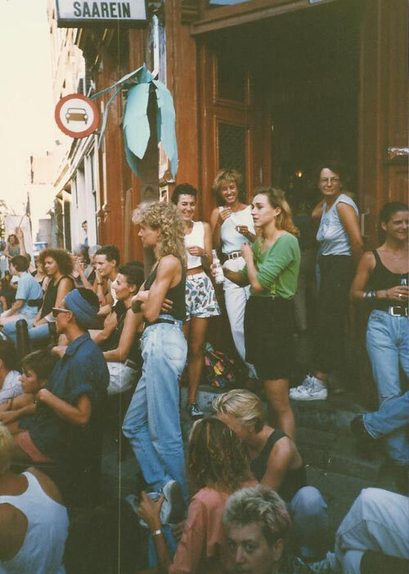
Foto: Babs Hogenkamp (bron: IHLIA)
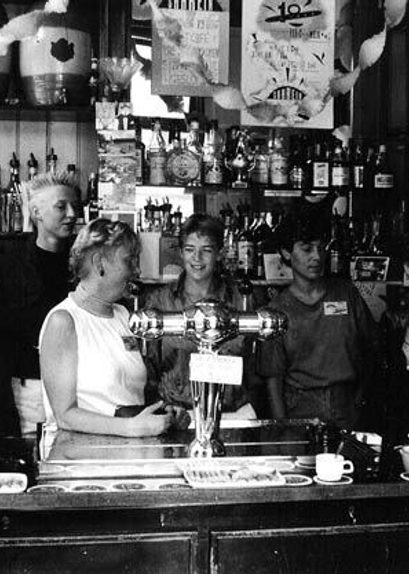
Foto van het tienjarig bestaan van Saarein in 1987 (fotograaf onbekend, bron: vrouwennuvoorlater.nl)
It's revealing to know that the café was first registered under the name 'Stichting het Amsterdams Vrouwencafé' (The Amsterdam Women's Café Foundation). Café Saarein is the oldest surviving women's café in Amsterdam, nestled in the Jordaan since 1978. Women from the Lesbian Nation collective, together with others, formed an initiative group to establish a new pub. The place made it possible for women to socialise without unwanted attention from men. Initially, Café Saarein was open only to women, most of whom were lesbian. In its early years, the small group of regulars often formed a tight-knit clique, something you can catch a glimpse of in the next clip.
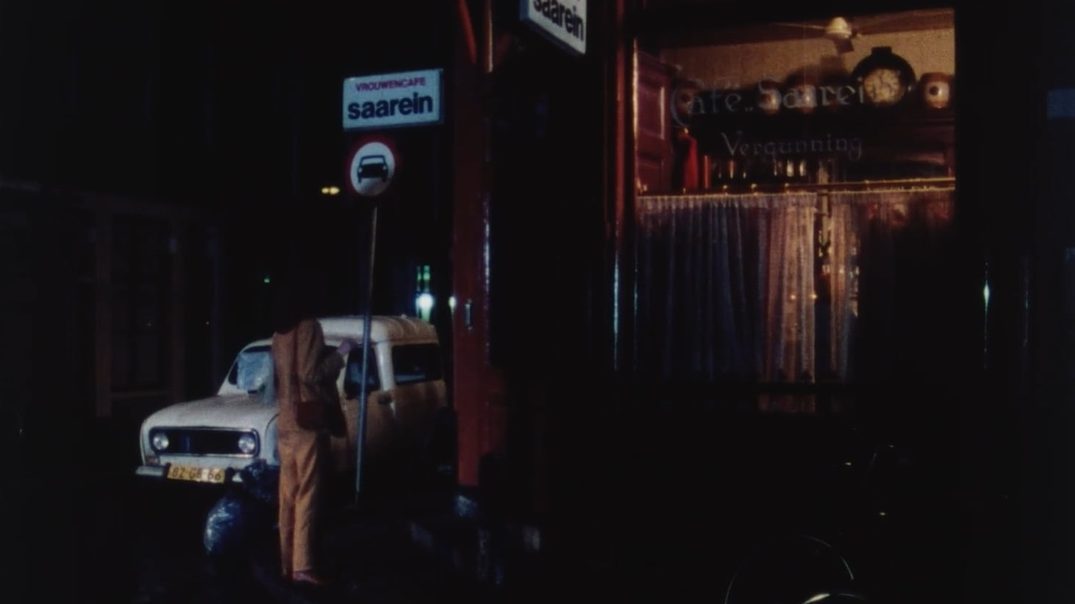
Knowing that our brunette from the previous clip is questioning her sexual orientation, you'll see her pass Café Saarein without daring to enter, perhaps not feeling she belongs to the community, or maybe hesitant because of the tight-knit group of feminists and lesbians who ran it. This clip doesn't mention the café by name, but you'll recognise it immediately. And let's be honest: in Amsterdam at the time, it was the most obvious place for two women romantically interested in each other to meet.
Visual and verbal signals
Not every signal (hidden or otherwise) is about local knowledge: sometimes it's simply a matter of watching carefully and remaining open to alternative readings of a scene. The following clip from Krokodillen in Amsterdam (Crocodiles in Amsterdam, Annette Apon, 1989) illustrates how a scene can carry a sexual undertone, for those who choose to see it. Watch the carvings in the door (a schematic form of a vulva?), and how nervously the woman behaves: the way she prepares herself, her nervousness, and what it might mean within the film for her to push the door open, given that her bond with another woman is deepening, even if the film never explicitly shows a romantic relationship.
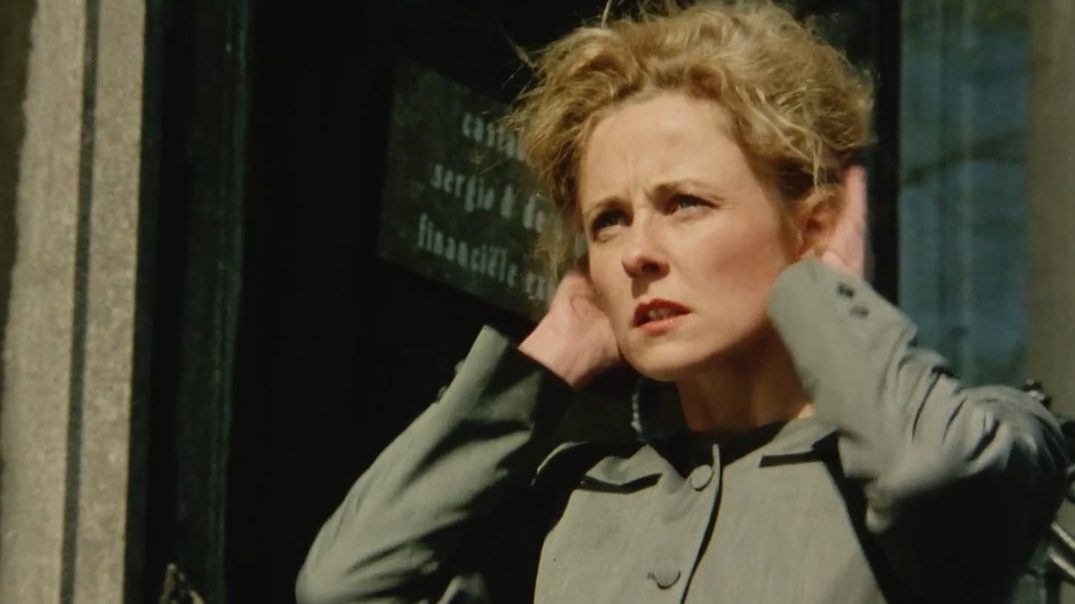
You don't have to agree, but you could read the act of pushing the door as a metaphor for penetration: her desire for intimacy with the other woman.
Back to De geest van gras, for me one of the richest examples of queer coding, full of signals that lend themselves to different interpretations. The film is a collaboration between Marleen Gorris and Mieke van Kasbergen, two women deeply embedded in Amsterdam's feminist movement. It followed shortly after Gorris's debut, the wonderful De stilte rond Christine M. (A Question of Silence). Gorris had initially hoped Chantal Akerman would direct her debut screenplay; it was Van Kasbergen who eventually asked her to direct De geest van gras herself. Outside the film world, Van Kasbergen co-founded the Lesbian Nation collective (the same group behind Café Saarein) and worked for the feminist radio programme Hoor Haar (Listen to Her), for which she interviewed figures including Monique Wittig and Adrienne Rich.
Dutch newspaper De Volkskrant paid explicit attention to the film's queer coding at the time. Gorris herself was quoted as saying that the audience had to sense for themselves why the protagonist ultimately only enters into relationships with women. And, speaking to Nieuwsblad van het Noorden, she said: “[Marjan] is also building stronger connections with other women because of it. With one woman in particular – and whether that is lesbian or not is for everyone to decide for themselves.”
The following scene from the film is telling:
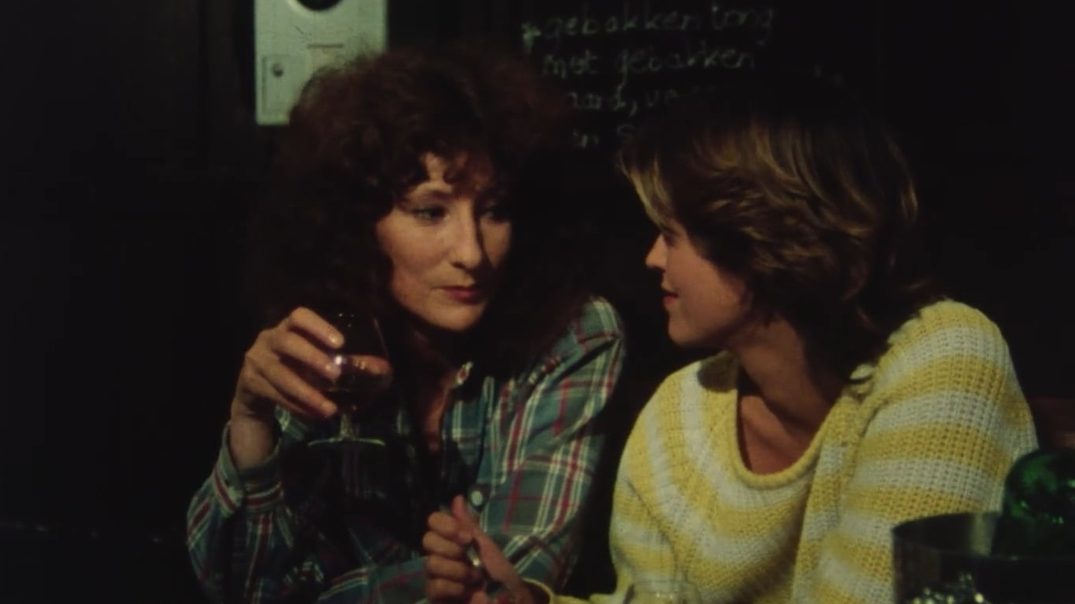
Watch the pullover of the woman on the right, and what happens to it. Observe the body language. When the cut appears, what do you think happened between them? This one plays with the power of an ellipsis where a thoughtful cut between evening and morning can mean much more than only a time-lapse. It gives us the freedom to picture what could not be shown. Keep this in mind and you'll grasp this scene too. Even the menu board behind them seems to offer clues – one can read the words “mosselen” [mussels] en “tong” [sole, but also tongue in Dutch].
The final example is not about images but about words. In the next scene from Krokodillen in Amsterdam, listen to the dialogue: an animal metaphor is used to describe a minority that hides and blends in. Here’s a hint: replace the word "crocodile" with "lesbian" – or another marginalized group – and the dialogue takes on a very different meaning.
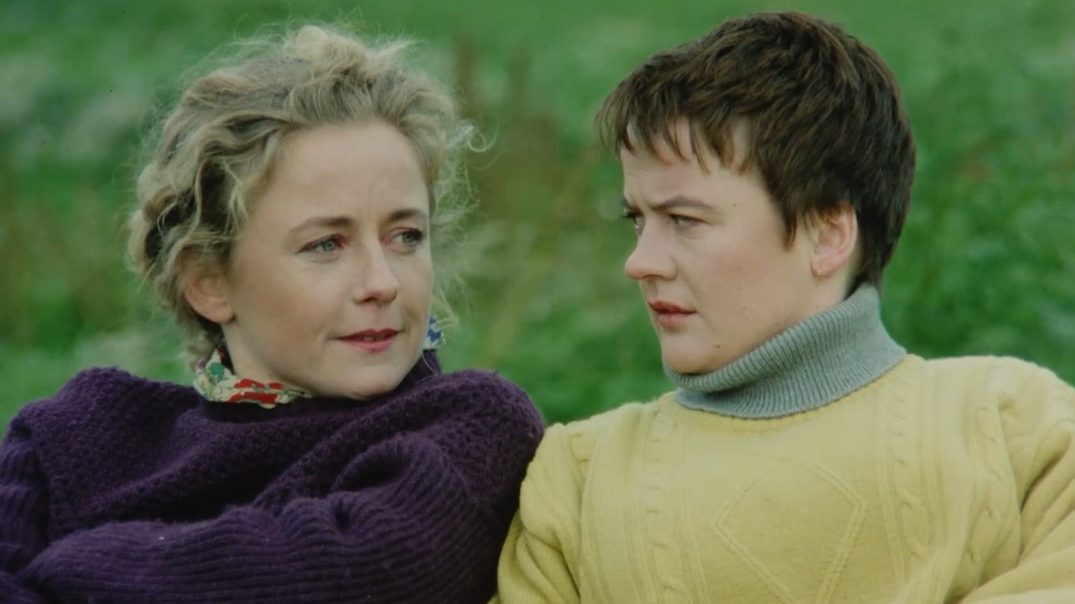
A pair of glasses you can put on
What my research shows, above all, is that queer coding is not merely a trick from an era of censorship, but an active way of reading: something you can train, just like a language. Sometimes it's a matter of paying close attention: a look that lingers just a little longer, a door pushed just a little more hesitantly. Sometimes it calls for historical knowledge: a triangle, a flower, the address of a café for women. Together, these two skills form what I call the queer glasses. You don't put them on to discover something that isn't there, but to see what was always there, hidden in plain sight.
The pictures included in this article are from the Eye collection, unless otherwise noted. The clips are taken from yet unrestored material. Eye Filmmuseum will preserve these works in the near future.