
With whispers of a possible Third World War, fairy tales like Pan's Labyrinth sound ominously relevant. Since the dawn of humanity, fairy tales have been a way to understand our inner world. Swiss psychiatrist Carl Jung described it this way: "The fairy tale is the purest and simplest expression of collective unconscious psychic processes." It's no coincidence, then, that fairy tales gain popularity precisely in times of social unrest. They serve as guides when the uncertainty of life confronts us with unfamiliar realms within ourselves. What can Pan's Labyrinth teach us about how to deal with war, the rise of artificial intelligence, and political instability?
I first saw Guillermo del Toro's dark fantasy film as a teenager. Like many my age, I was fascinated by magical worlds I could escape to. At the time, I thought: a magical world is obviously better than a world without magic, right? But in retrospect, I see that those worlds were primarily a refuge. Not from an actual war, but from the struggle within myself. From the hormones raging through my body, the confusion I felt the moment I left the safe walls of my home. Any woman who ever wore a sanitary pad for the first time in high school knows what I mean: leaking is social bankruptcy.
In Pan’s Labyrinth, young Ofelia (played by Ivana Baquero) flees her unforgiving reality by following a fairy to a magical world. Her life is not going well at that moment. Her stepfather is a sadistic man waging war against the rebels in Spain in 1944. Her mother is heavily pregnant and ill, leaving her largely on her own.
Ode to cinema: Pan's Labyrinth
Tess Milne is a writer, programme maker and storyteller with a deep love for film. In her work, she always seeks the human element, whether on television or written in words. For Eye Filmmuseum, she writes the column Ode to Cinema, in which she offers her personal perspective on the magic of film – from childhood memories to unexpected discoveries in the film archive. The kickoff: Guillermo del Toro's dark fairy tale Pan's Labyrinth (2006), which will be screened at Eye on 20 July, on 35mm and with an introduction.
By Tess Milne15 July 2025
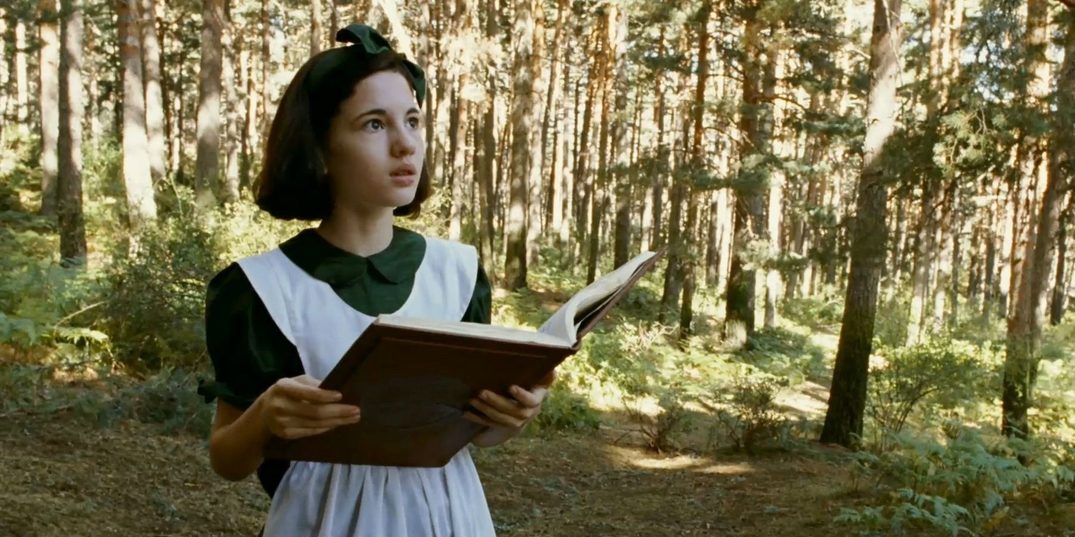
still Pan's Labyrinth (El Laberinto Del Fauno) (Guillermo del Toro, ES/MX 2006)
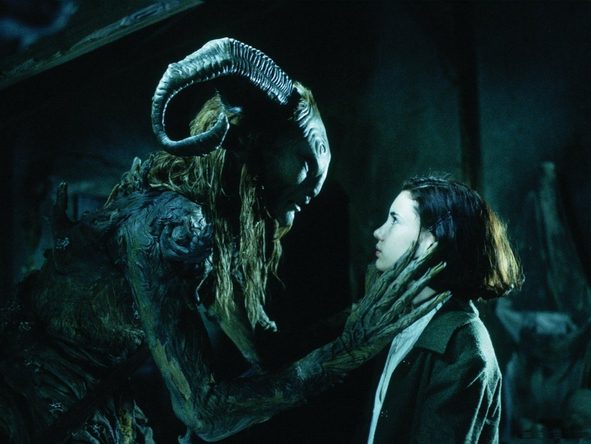
still Pan's Labyrinth (El Laberinto Del Fauno) (Guillermo del Toro, ES/MX 2006)
Ofelia's fantasy world initially seems like an escape, but it's actually an inner journey filled with moral choices and trials. She literally descends into the dark depths of her psyche, into the labyrinth of her shadow world. She's confronted with monsters that symbolize her fears and dilemmas. Yet, in these horror caverns of human existence, she is the one who makes the decisions and holds the power. In your imagination, you determine what happens, and that alone is an act of resistance.
The film also indirectly poses a question that is just as relevant today: how do we respond to authoritarian rule? I remember well inquiring about the virus's origins at the beginning of the coronavirus pandemic. I was met with a fierce reaction, as if I were a traitor. Ultimately, it turned out the virus may indeed have originated from a laboratory leak. It taught me an important lesson: in times of fear, even asking a simple question quickly becomes an act of resistance. This means that in troubled times, we must ask ourselves what it means to be human – and especially: to remain human – in inhumane circumstances.
It's tempting to analyze Pan's Labyrinth based on what's "real" and what isn't. Did Ophelia make it all up? Was it fantasy or reality? But according to Guillermo del Toro, everything is real. Stories are real because they reveal universal, human truths. Fairy tales aren't about escaping reality, but about finding truth in another language. For example, the story of Little Red Riding Hood seems to be about a girl and a wolf, but it warns us, without literally saying so, about the danger of sexual violence. The problem with some modern, more recent fairy tales is that they flatten the truth or sometimes erase it entirely. Which, in the case of young children, I understand. But the underlying feeling is still palpable. And what does this teach us? That we can't trust our gut?
"Fairy tales aren't about escaping reality, but about finding truth in another language."
That's absolutely not the case with Pan's Labyrinth.
Del Toro deliberately chooses not to soften the story.
He trusts the audience can handle the film.
Although I have to admit, this wasn't the case for me until the very end.
Ofelia's journey through the darkness is an inner journey. And in a way, it's precisely the journey we all make in dark times: from an ego stuck in a new reality, to a transformation into who we truly are. The empathetic observer. One who isn't guided by fear and violence. Thus, as in every true fairy tale, only at the end of the darkness do we rediscover our true self. And beyond that ego, perhaps you can truly speak of a Happily Ever After.
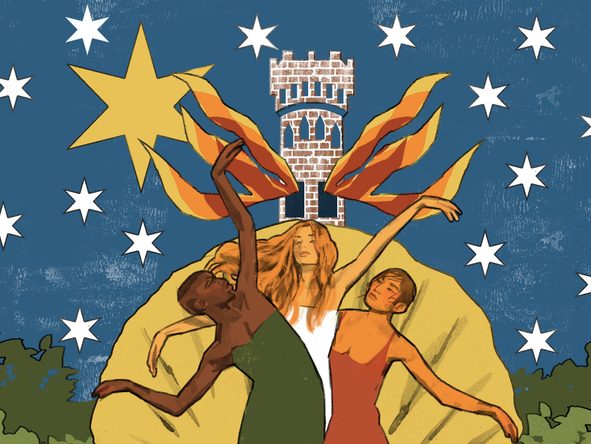
© Kim Thompson
The Tower of Crossed Destinies
Pan's Labyrinth will be screened as part of the film programme The Tower of Crossed Destinies, curated by Programmer of the Future Alicia Bergamelli. She will present a two-day programme on folklore, fairy tales, and mythology at Eye and the Eye Film Player on 23 and 25 July 2025. The Tower of Crossed Destinies follows the forgotten paths of enchanting fables that have shaped cinema across generations and cultures.