Skip to content

Tilda Swinton and the Art of the In-Between

From the start of her career, Swinton’s androgyny has been a lens through which she has guided many of her audiences towards an understanding of gender outside of societal norms. In this article, writer and cultural analyst Diede Al dives deeper into Swinton’s gender fluidity and explores how Swinton uses her ethereal look to challenge society’s rigid gender roles.

By Diede Al24 November 2025

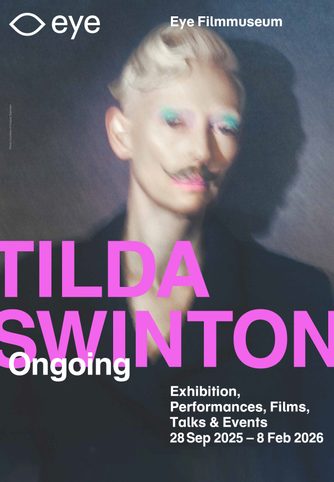
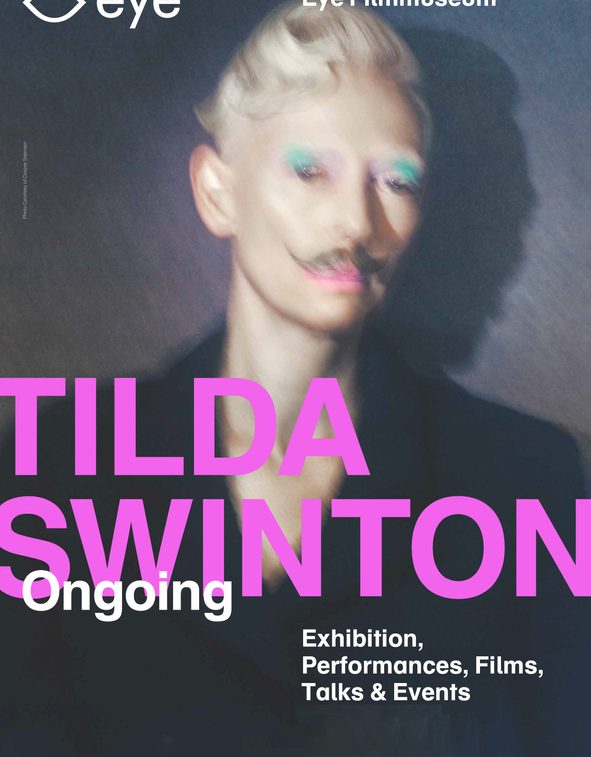
Tilda Swinton, her short white hair combed in a side part, wearing blue eyeshadow, a suit jacket and a false moustache. It is the image for the poster of Eye’s current exhibition Tilda Swinton – Ongoing. The image, that can be seen throughout Amsterdam and beyond, is blurred, as if it was captured mid-movement, as if the picture shows something that is ever evolving. The image references the exhibition’s title, while also reflecting what Swinton is well known for: her androgyny.

poster Tilda Swinton – Ongoing

Nature, nature, I am your bride

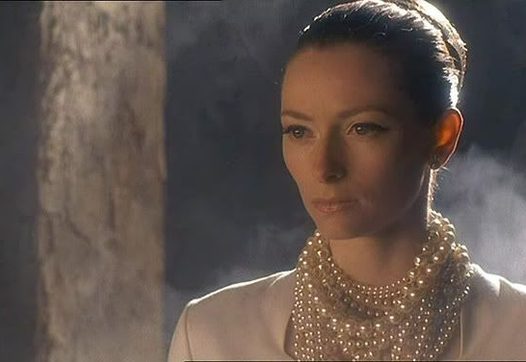
It is one of the most recognizable scenes in modern cinema: the immortal Orlando, after just having refused a marriage proposal from Archduke Harry, flees through a labyrinth. Lifting her blue robe à la française, which fills the narrow passages of the labyrinth, she keeps her gaze straight ahead and strides into a different century. When she makes her way out of the labyrinth Orlando’s powdered wig has changed into an 1850’s appropriate hairstyle and her robe à la française transformed into a deep blue Victorian gown, over which she trips. Orlando lays face down in a fog covered garden of the estate that, now that she’s a woman, is no longer in her possession.
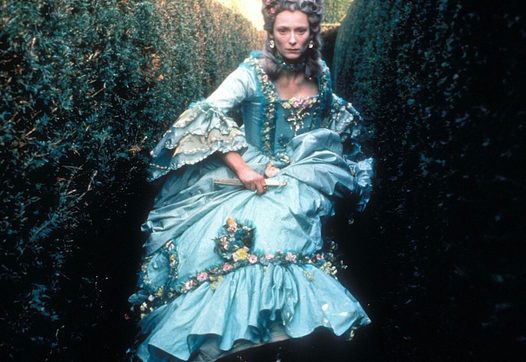

Orlando starts her flee through the labyrinth in a light blue robe à la française...

...and ends up in a deep blue Victorian dress.

Orlando was not always a woman, he used to be a man and as a man, as both Virginia Woolf’s novel and Sally Potter’s 1993 adaptation opens, ‘there could be no doubt of his sex’. It just so happened that Orlando woke up one day to find she had become a woman. To Orlando this amounted to little more than a coincidence, a natural occurrence for someone who lives over 400 years. The change of sex only becomes a problem once the politics of society enter the picture; Orlando is no longer listened to the way when Orlando was a man and only through marriage she can regain the rights to the estate that was promised Orlando by Queen Elizabeth I.

As Orlando lays down, her cheek against the dew-covered grass, she vows to the earth: ‘Nature, nature, I am your bride, take me.’ Orlando’s vow reveals that even the natural can be politicized. The scene highlights the interplay of nature and society, a theme mirrored in Tilda Swinton’s androgynous performance in the titular role of the film she developed together with Potter. Swinton’s androgynous look, both within and beyond her role as Orlando, challenges the rigid societal gender norms of the global north. Swinton’s androgyny is not just something to be gazed upon, it is through which she understands and critiques the rigid societal norms of gender expression. For Swinton, gender identity is not static, it changes:

“My idea of identity is that I’m not sure it really exists… I don’t know if I could ever really say that I was a girl, I was kind of a boy for a long time. I don’t know, who knows? It changes.”

Tilda Swinton in The Women's International Perspective (2009)

One Woman's Play

Tilda Swinton was widely praised for her gender-defying performance in Orlando. Her androgynous look, and her capacity to convincingly portray both iterations of the character, made her one of the most recognizable performers in film today. It is not surprising that many point to this role as the role in which Swinton embraced her androgyny. However, nurtured and formed as a performer by queer artists earlier in her career, Swinton’s performance in Orlando shows an actor who is already very aware of how her androgyny can carry political meaning. From the start of her career Swinton chose roles that challenge traditional gender norms and reflect feminist and queer perspectives.

Her feature film debut as Lena in Derek Jarman’s Caravaggio already makes this clear. As discussed in the article Hues of Blue, her portrayal of Lena as a woman who asserts her own agency within a highly patriarchal society created a character whose resistance is rooted in both feminist and queer sensibilities. Sensibilities she carried into the characters she played throughout her career. Her role as Queen Isabella in Jarman’s Edward II, a theatrical and camp portrayal of a queen that exposes the artificiality of gender, was followed by her role as Ella in John Maybury’s film adaptation of Manfred Karge’s one-woman play Man to Man (1993). Man to Man tells the story of a young widow in Weimar Germany who takes on the identity of her dead husband. In this role Swinton’s exploration of gender reached a new complexity, as her androgynous appearance became an integral part of the character.

Tilda Swinton in Edward II (Derek Jarman, 1991)

Tilda Swinton in Man to Man (John Maybury, 1993)

Swinton’s portrayal of Orlando was thus not the starting point of her exploration of gender identity and expression, but rather a logical continuation. Her work with Potter on Orlando was, she said in an interview with Cinéast in 1993, “another angle at which to come at the problem of gender specification, which was not to examine an occluded gender […] but an idea of limitlessness through the concept of immortality.” Through the character of Orlando Swinton conveys that gender, like Orlando’s immortality, is limitless.

With this very queer idea of gender as fluid and limitless, it is no surprise that Swinton in her personal life also tunes into this queer sensibility, as she told British Vogue, she “always felt queer”. In her work Swinton expresses this queer sensibility by embodying different characters across the gender spectrum. Her androgyny almost functions like a blank canvas onto which she carefully sculpts her characters, mastering the art of the in-between.

The Matriarch

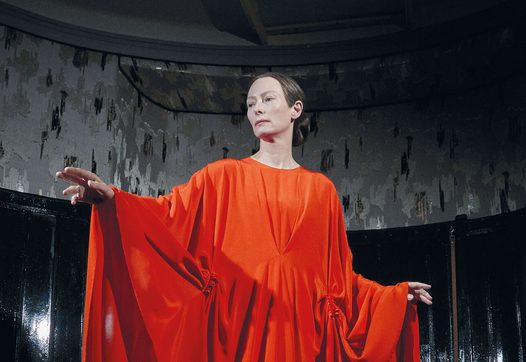
Building on Orlando, Swinton continued to take on more gender-defying roles. For Luca Guadagnino’s 2018 remake of Suspiria, she both played the character of Madame Blanc, the artistic director of the all-female ‘Helena Markos Dance Company’, and the elderly male psychoanalyst Dr. Josef Klemperer. In this supernatural horror film, we see the American dancer Susie joining the Helena Markos Dance Company in 1977’s divided Berlin after one of the dancers of the company goes missing. Susie immediately catches Madame Blanc’s eye and proves herself worthy of the lead role by dancing Madame Blanc’s choreography with a ritualistic intensity that moves beyond the confines of the body.

Tilda Swinton as Madame Blanc in Suspiria (Luca Guadagnino, 2018)

Tilda Swinton as Dr. Josef Klemperer in Suspiria (Luca Guadagnino, 2018)

Suspiria explores themes of female agency, empowerment, and bodily autonomy, using the horror genre to critique societal power which seeks to regulate women’s bodies. This theme is explored through dance, with the choreography functioning as a ritual that instrumentalizes the dancer’s body. Swinton’s dual performance as both Madame Blanc, the matriarch of the matrons who govern the dance company, and Dr. Josef Klemperer further develops this theme. Showing both the internal perspective of female power and the external male gaze of patriarchal control. By playing both these roles Swinton reveals the complexity of patriarchal power, which women’s bodies are required to sustain, but which can also easily be taken away from them. Her androgynous doubling in Suspiria destabilizes and exposes the rigid gendered framework of power and how that power is regulated.

This destabilization and regulation of power through the performance of gender is also notable in how Suspiria deals with the theme of motherhood. The dance company votes for a new leader, a new ‘mother’, who will be the one in charge. Both Madame Blanc and ‘Mother Markos’ are contenders for this position, but already being the artistic director of the dance company Madame Blanc seems to be the most obvious choice. However, Madame Blanc’s aspiration to this power, a power she already holds, will eventually be punished. Although exaggerated through the lens of horror in Suspiria, Swinton’s engagement with the complexities of motherhood can be seen throughout her work.

(M)motherhood

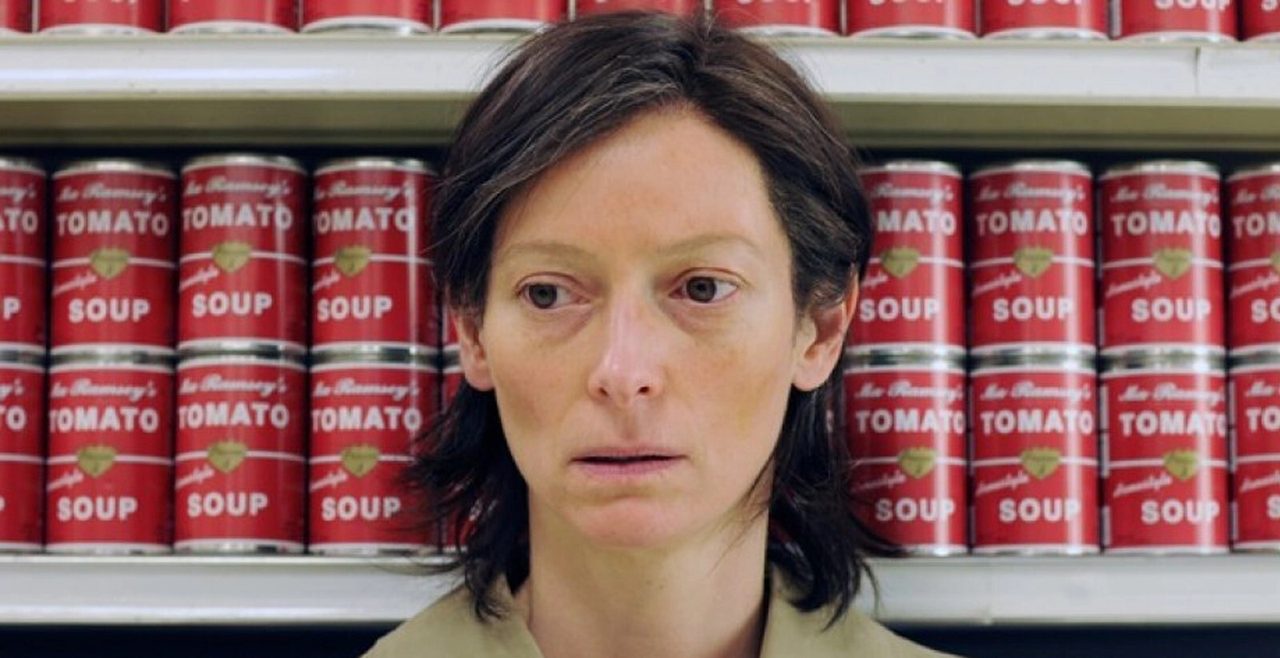
In 2011 Swinton played the role of Eva in Lynne Ramsay’s film We Need to Talk About Kevin. Shown from Eva’s perspective, Ramsay’s film tells the story of a mother who is not naturally drawn to motherhood. When Eva, a successful travel writer from New York, welcomes her first child Kevin he seems hostile towards her and shows unsettling behaviors, behaviors that lead to life altering horrors. In striking visual metaphors and through a fragmentary plot, the film shows the psychological trauma of a mother in the aftermath of an unimaginable crime committed by her son.

The film shows how motherhood is shaped not only by personal experience but also by societal expectations and gender norms. However, We Need to Talk About Kevin does not suggest that motherhood never comes naturally, but rather highlights how societal expectations shape and constrain the way maternal care is performed. In the film, we see this in the difference between Eva’s care for Kevin and her daughter Celia. While her affections toward Celia seems to come naturally, this same care is denied by Kevin. Thus, Eva both inhabits the category of ‘mother’, as how it is prescribed by societal and gender norms, and is denied access to this category. She is not inherently a 'bad mother', yet after Kevin commits an unthinkable act of violence she is perceived as one, which forces her to question her own choices: was this tragedy inevitable, or could it have been prevented had she been a ‘better’ mother?

still from We Need to Talk About Kevin (Lynne Ramsay, GB/US 2011)

still uit We Need to Talk About Kevin (Lynne Ramsay, GB/US 2011)

To the outside world Eva seems cold and distant, and her almost detached appearance allows others to project their judgements onto her. She is repeatedly othered by her community, but not only because of her son’s actions. The othering also appears because she does not conform to the rigid societal norms of what a ‘good mother’ is expected to look and act like, a norm she had already been denied inhabiting by her son. Swinton’s remarkable performance of suppressed emotion shows an actor who knows how to embody both the coldness through which the character of Eva is perceived, as well as the warmth of the person that lies beneath it. Swinton is a chameleon of emotions, while always being recognizable. Using her ethereal appearance to convey the complexity of gender and gender performance.

The In-Between

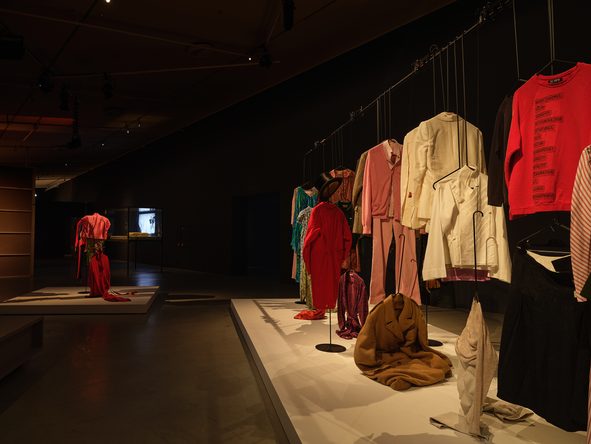
When you get close enough, you can hear the soft rattling of coat hangers, slowly moving up and down, showing items from Swinton’s wardrobe in the middle of the Ongoing exhibition space. In the first weeks of the exhibition, Swinton performed A Biographical Wardrobe together with fashion historian and curator Olivier Saillard. During the performance Swinton told stories from her life, like the time her mother tried to make her more ladylike by fitting her in a floral dress.

A Biographical Wardrobe (Olivier Saillard, 2025) (© Studio Hans Wilschut)

A Biographical Wardrobe (Olivier Saillard, 2025) (© Studio Hans Wilschut)

In the exhibition space the wardrobe speaks for itself. The items vary from a Chanel dress she wore on the red carpet, to a Raf Simons sweater she wore when she first met Luca Guadagnino.

Through the garments, the transformative quality of Swinton is highlighted, an artist who uses her art to explore the in-between. From her time- and gender-bending performance in Orlando to Suspiria’s dual embodiment of power, and the fraught performance of motherhood as Eva, through her performances Swinton continually speaks on rigid societal gender norms. Her androgynous look is not merely an aesthetic, but a way to explore gender in all its fluidity and complexity. Swinton reminds us that gender identity is never fixed, but something to be explored, expanded upon, and ultimately celebrated.

poster Tilda Swinton – Ongoing

All films mentioned in this article are screened in the film programme accompanying the exhibition Tilda Swinton – Ongoing.

Eye Film Player

At home, you can join in via Eye Film Player: films starring Swinton, the 14-hour documentary Women Make Film, and video registrations of her conversations with her artistic partners and friends in Eye.

Watch online